Middle-Earth: A World Worth Fighting For
Showing posts with label Gondor. Show all posts

Tuesday, January 29, 2013

'Ride now to Gondor!' - In Praise of the Riders of Rohan

First, I want to give thanks for Jef Murray's post (which is excellent BTW) for inspiration for my own; though I've been meaning to post this reflection for a while. (all songs and quotes are from The Lord of 
the Rings unless otherwise noted)

the banner of the White Horse: the flag of Rohan

'Were now the horse and the rider?...
Where is the horn that was blowing?...
Darkness took them, horse and horseman.
Hoofbeats from afar sank into silence...
The days have gone down in the West...
To hope's end I rode, and to heart's breaking...
Ride now to Gondor...
Fell deeds awake; fire and slaughter...
Red fell the dew in Rammas Echor.'

The above lines are a mix-mash of various Rohirric poetry as is found scattered throughout The Lord of the Rings. In these laments and songs - 'laden with the sadness of Mortal Men' - can the whole belief-system of the Sons of Eorl be derived. The Rohirrim are Tolkien's most respected and exalted sub-created tribute to the Northern pagan peoples of the pre-Christian ages. Although the Rohirrim do have a fuzzy knowledge of the Valar (they credit Orome the Great for bringing the sire of the ancestors of Shadowfax to Middle-Earth) no specific religious practices (apart from King Theoden blessing Merry) are mentioned or described by Tolkien anywhere in the book (which was delibrete on Tolkien's part). Instead, the Men of Rohan's worldview and beliefs can be found in the songs that they sing, for they have yet no written language of their own. Reading these poems, I am struck by the desperate joy in the face of death and doom these people express in their songs. At the Battle of the Pelennor fields King Theoden and Eomer the Marshal know almost for a fact that they are riding to their deaths, yet even with this knowledge the aged King still says to his men as they rally about him before the ride to Minas Tirith: ' ''Now is the hour come, Riders of the Mark, sons of Eorl! Foes and fire are before you, and your homes far behind. Yet, though you fight upon an alien field, the glory that you reap shall be your own forever. Oaths ye have taken: now fulfill them all, to lord and land and league of friendship!'' '


Theoden-King riding into battle

This little pre-battle speech by Theoden is a vital insight into the whole Rohirrim code of honor: First, he reminds his warriors of their oaths: long ago Eorl the Young lent unlooked for aid to the Steward Cirion of Gondor and in thanks for this the Steward gave to Eorl's people the lands that they now dwell in to be their own forever, and both Eorl and Cirion swore oaths (and here Cirion called upon God - Eru the 'One' - and the Valar to be witnesses of the event) that the two kingdoms would live in perpetual alliance and friendship with each other, unless one or the other should full under the Shadow of Sauron. Now, hundreds of years later, Theoden fulfills these same oaths, still seeing himself bound by them, regardless of the great passage of time. They are just as relevant today as they were when they were made, for 'now is the hour.' Second, he bids them to remember who they are: the sons of Eorl and Riders of Rohan, uplifting them with the honor of their ancestry and heritage which (to them) is long and glorious. Third, he does not deny the doom and death facing them but makes mention of a reward. But what reward can there be if they all should die? Not an earthy reward, certainly, but one that touches more on eternal truths, even though the Rohirrim have only a very dim understanding of God and the Powers: 'the glory that you reap shall be your own forever,' Theoden says but what does he mean? Basically he is saying that by honoring the ancient Oath of Eorl and riding to the aid of Gondor and fighting on the Pelennor Fields the Rohirrim are fulfilling themselves in the highest way they know, and that their deeds, even though they may not be remembered, will nonetheless remain great and glorious; not lessened in worth by whatever should happen in the future, even if Sauron should win. And last, Theoden brings forth the chief values of his people (which are the chief values of any honest, noble-hearted people): the love of their lord, their land, and their league of friendship. The Riders of Rohan are not just Gondor's allies, they are also their friends, and as they have done so many times in the past, so also they do now in the War of the Ring, arriving beyond hope just as the Gates of Minas Tirith fall, 'for morning came, morning and a wind from the Sea; and darkness was removed, and the hosts of Mordor wailed, and terror took them, and they fled, and died, and the hoofs of wrath rode over them. And then all the host of Rohan burst into song, and the sang as they slew, for the joy of battle was on them, and the sound of their singing that was fair and terrible came even to the City.'

The Rohirrim fighting in the Pelennor Fields

During this battle, King Theoden slays the leader of the Southrons before he and his knights are attacked by the Witch-King. He is crushed beneath the body of his horse and passes out and does not witness the final confrontation between Eowyn, Merry and the Black Captain. When he comes to he finds Merry the hobbit (who he has become good friends with and who has sworn himself into his service) weeping alone by his side. Their brief conversation is quite moving, for Theoden, now dying, speaks of his gladness to depart this life in honor, seeing his efforts as neither wasteful nor tragic: ' ''Farewell Master Holbytla! My body is broken. I go to my fathers. And even in their mighty company I shall not now be ashamed...
A grim morn, and a glad day, and a golden sunset!''  
So the King of Rohan dies in peace in the middle of a bloodied battlefield, having fulfilled his oaths, content to have been able to fight against Sauron once more after many years of uselessness and weakness under the influence of Grima Wormtongue. ''Ride now to victory! Bid Eowyn farewell.'' are his last words to Eomer, who is now the King of the Mark. But when Eomer he sees his sister also lying near Theoden, he believes that she too is dead, and is filled with rage and despair and he cries out in out in anguish over the hosts of Rohan, saying: ''Death! Death! Ride to ruin and the world's ending!'' But although their charge is powerful and their swords bitter and skilled, the armies of Mordor and Harad greatly outnumber the Rohirrim and Eomer, when he sees the black ships of the Corsairs of Umber coming up the Auduin, knows that the hour of their doom is at hand and death is come to him and all his warriors. But still even then, he does not flee, but riding to a hill he displays the banner of the White Horse and raises his sword in defiance, singing his death-song:

''Out of doubt, out of dark to the day's rising
I came singing in the sun, sword unsheathing. 
To hope's end I rode, and to heart's breaking:
now for wrath, now for ruin and a red nightfall!'' 
   
       
Eomer; Marshal of the Riddermark
''To hope's end I rode and to heart's breaking.'' This line
alone is gut-wrenching because here Eomer is expressing very deep powerful emotions that normally an author wouldn't let a grown, mature, battle-seasoned man show. Hope has ended; his loved ones lie dead; what then is left for him to do but prepare in the only way he knows how to meet his own end?
Eomer is a much more dynamic character in the book then he is in the movies (he smiles a lot more for one thing), and when you read this song you are reading the desperate lament of of a man who
believes that he is about to die along with his King, his sister, and all the Riders under his command as well as all those in Minas Tirith whom they are trying to aid. Yet still he intends to fight to the utmost end, 'and do deeds of song on the fields of Pelennor, though no man should be left in the West to remember the last King of the Mark.'
Eomer is in the prime of his life, healthy and strong, a great warrior and leader of men, but even he is not immune from the agony of loss and defeat and the knowledge of impending death. And the death-toll is indeed massive 'for it was a great battle and the full count [of the slain] no tale has told.'
There is no movie Green-Ghost-Army to come and save the survivors from all those annoying orcs and
Oliphaunts, only living men with blood, sweat and tears who come with Aragorn to fight and die to win victory for Minas Tirith and Osgiliath. But they are remembered, and many of the minstrels of Rohan are busy long after the War with the making of laments and dirges for those who fought and fell in the Great Battle, with 'The Song of the Mounds of Mundburg' being chief:


From oath-keeping to death-dealing (and taking) the people of Rohan exhibit great courage in the face of overwhelming odds, coming to the aid of their allies even though many know that the giving of such aid will only add their bodies to those of their friends. But their love for 'lord and land and league of friendship' override their their fear of peril and death, and they ride to Gondor, to fell deeds under a red sun, their war horns echoing like thunder in the mountains. The language Tolkien utilizes to capture the 'Ride of the Rohirrim' is for me the most awesome and glorious in all of The Lord of the Rings; epic in scope, brief yet profound. One moment you're looking over Merry's shoulder at King Theoden as he gazes in grief upon the burning City of the Sea-Kings, looking old and frail, inwardly debating whether to charge or to ride quietly away and hide in the hills, and then suddenly he rises up in his stirrups and cries out:

''Arise, arise, Riders of Theoden!
Fell deeds awake: fire and slaughter!
Spear shall be shaken, shield be splintered,
a sword-day, a red day, ere the sun rises!
Ride now, ride now! Ride to Gondor!''

He charges, and Tolkien takes you and sets you on a high place where the whole battle can be viewed in
its entirety, and we see King Theoden being 'borne up on Snowmane like a god of old' riding far ahead of
his hosts and the orcs of Sauron wailing and dying and the sun rising, and we are filled with hope and joy
and it is the heroes we are cheering for and the good we are affirming - for these are Men, like us, doing
deeds of valor and honor for their friends that will remained ingrained in our imaginations - to help and
heal and console us when we ourselves sit in our own falling cities under the shadow of death, waiting for
the hope of the Dawn and the rising of the Sun.

The Ride of the Rohirrim
'Doom drove them on. 
Darkness took them, 
horse and horseman;
Hoofbeats afar sank into silence: 
so the songs tell us.'


''So the songs tell us.'' These lines of this poem were made long after the War of the Ring was over and already one gets the impression that the events are already sinking into the realm of lore and myth, to fireside stories and long Beowulf-style poems sung by minstrels in other Golden Halls, recalling the fading memories of the 'Ride of King Thoeden the Old to the Battle of the Pelennor Fields', even as they recalled in earlier ages the 'Ride of Eorl the Young to the Battle of the Field of Celebrant'. It is this rich sense of history that makes Middle-Earth such a believable world. Tolkien never intended Middle-Earth to be set in a parallel universe or on another planet. The events of The Lord of the Rings happened in this world, in a 'imaginative space' created by the lore-wise Professor, and the book itself is written in such a way that can make you believe that once upon a time, an old king named Theoden, a simple lord of plains and vales and horses, led his Riders to the aid of the great City of a highly advanced civilization founded by the survivors of the kingdom of Atlantis, and did deeds of song that were eventually written down (along with many other great tales) in a Red Book by three Hobbits, a copy of which was eventually translated by John Ronald Ruel Tolkien for the enjoyment and uplifting of those dwelling here and now in the Age of Men. For the Rohirrin are Men like ourselves, fallible, mortal and forgetful, but they are brave and courageous and steadfast in keeping their oaths, which is far better then many of us can say of ourselves in this current age. Yes, Elves are awesome, Hobbits are delightful and Ents are flat-out-amazing, but in the end, we the readers are 'Mortal Men doomed to die' and Tolkien presents to us a vision of our own race magnified and exalted, winning honor and glory in spite of mortality and death, in spite of the fact they lived in a pre-Christian age, long before the Incarnation of Eru, not knowing what lay in store for them after they'd left their fallen bodies upon the fields of Gondor. But that did not stop them from doing the deeds at hand. ''Doom drove them on. Darkness took them...'' Yet still they rode on, on to the 'Sea-King's city in the South-Kingdom: foe-beleaguered, fire-encircled' dying far from home and hearth and the green pastures of their fair land. No men display greater love then those who lay down their lives for their friends. King Theoden and his Riders did so, and their rewards will truly be great.


Theoden the Renowned; Lord of the Rohirrim
  
'Forth rode the King, fear behind him; fate before him.
Fealty kept he; oaths he had taken; all fulfilled them.'

'Red fell the dew in Rammas Echor'

Saturday, January 19, 2013

A Tribute Post to the Real Captain Faramir


A tribute post to Tolkien's real captain Faramir. What Peter Jackson did to him in The Two Towers movie was disgusting.

Faramir, captain of Gondor retreating out of
Osgiliath


Just in case some people are still not sure about this:

A Tale of Two Faramirs 

Tolkien-Faramir: ''I would not take this thing [the Ring], if it lay by the highway. Not were Minas
Tirith falling into ruin and I alone could save her, using the weapon of the Dark Lord for her 
good and my glory. No, I do not wish for such triumphs, Frodo...I am not such a man...
Fear not! I do not wish to see it, or touch it, or know more of it then I know (which is enough)...''

Jackson-Faramir: ''The Ring will go to Gondor...Take them [Frodo and Sam] to my father; tell him Faramir sends a mighty gift: a weapon that will change our fortune in this war.''

Confused? Jackson lied to us; he slandered/misportrayed Tolkien's character and made the most brave, noble-hearted man in The Lord of the Rings into a hard-bitten goon and his rangers into a pack of cruel Gollum-beating thugs. Every noble/touching moment between him, Frodo and Sam was completely glossed over; the beauty trampled. And one day, if this blog ever becomes popular, readers are still going to wonder why I dislike the Peter Jackson films.


*   *   *

Faramir as a ranger in Ithilien forest

I'm going to keep this simple and short (actually not: that would make
me 'hasty'). I'm taking a break from Aragorn, and focusing on my second-favorite character: I'm going offer up more of a tribute/defense of Faramir then a biography - so if you haven't read the book and don't know much about Faramir as Tolkien portrayed him, this post may not make much sense (special thanks to Anke Eissmann for all her great cannon-keeping Faramir/LOTR art).

Faramir is probably one of the finest of Tolkien's mortal heroes (including the ones in The Silmarillion as well). For me this reason it not because he's a badass warrior that has a lot of amazing adventures and does a lot of epic things (like Beren One-Hand), but simply because he is a man who at one point holds the fate of Middle-Earth in his hands and makes the right choice, like Bilbo did so long ago, and becomes apart of the great company of beings who have been entwined by Eru into the plan that ensures that Frodo, even though he himself fails, does not fail in the destruction of the Ring of Power.

Faramir is a man who thinks before he acts; he is wise and can read the hearts and minds of people to a certain degree. He is a lover of music and lore, and many find that strange: that a warrior and a captain of men could also be so gentle and so kind. This type of attitude displeases Denethor: ''Ever your desire is to appear lordly and generous as a King of old, gracious, gentle,'' he tells Faramir. ''That may well befit one of high race, if he sits in power and peace. But in desperate hours gentleness may be repaid with death.'' Faramir's reply: ''So be it.'' As I have have stressed before, Tolkien, in once spoken sentence, can lay bare the inner hearts and beliefs of his characters far better then ten pages of angst-ridden 'I-point-of-view' psychoanalysis. Here Faramir displays great moral integrity: he refuses to let the outside times and events define or invade upon his innermost virtues and values. After all, it is one thing to be nice and generous to others during peacetime, or when one has great wealth, but when war or financial collapse strikes, then these same people hoard their goods and grab their weapons and become totally different people then who they were before. Faramir refuses to do this. This is what makes him a great hero and leader, and all the soldiers in Gondor are devoted to him. Beregond the guard's cries of fear and anger when he sees the Nazgul assault Faramir and his men outside of Minas Tirith echo the feelings of love and respect everyone has for Denethor's youngest son, except Denethor himself.

Faramir refusing to abandon his men to the terror of the Nazgul

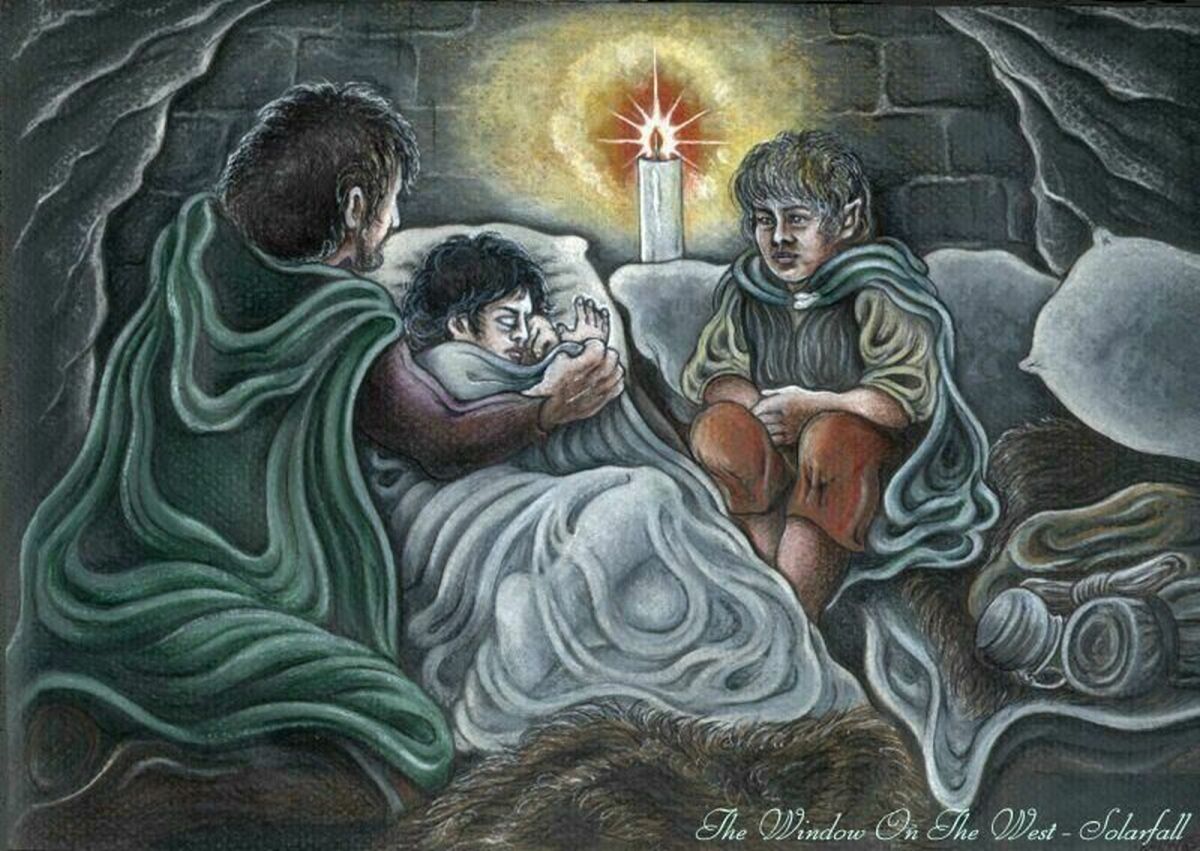
Faramir also seeks out knowledge and wisdom - much of which he learns from Gandalf, who he befriends - and studies history, not so he can lord it over people, but so he can make informed decisions and wise choices, often in conflict with the will of his father (who considers him a 'wizard's pupil'). When Frodo, Sam and Gollum wander into Ithilien forest, Faramir has his orders: he must slay all who trespass into Gondor's lands who do not directly serve the Steward Denethor. He could have chosen to have Frodo and Sam killed the minute he found them but does not...''I do not slay man nor beast needlessly, and not gladly even when it is needed,'' he tells Sam. As he talks with Frodo and slowly learns about the quest of the Fellowship and eventually - after a slip-up from Sam - the truth about ''Isildur's Bane'' and the madness of Boromir he is filled with grief and dismay rather then anger and Ringlust. Nor is the irony of the situation lost on him: ''So this is the answer to all the riddles!'' he cries. ''The One Ring that was thought to have perished from the world. And Boromir tried to take it by force? And you escaped? And ran all the way - to me! And here in the wild I have you: two Halflings, and a host of men at my call, and the Ring of Rings...a chance for Faramir, Captian of Gondor, to show his quality! Ha!'' Then comes the crucial moment of choice: ''Not if I found it on the highway would I take it,'' I said. Even if I were such a man as to desire this thing...still I should take those words as a vow, and be held by them. But I am not such a man.'' Faramir is a great enigma among Men: the desire for the Ring does not seem to exist within him. He waits and thinks, and taking Frodo and Sam to his secret refuge they dine with him and his men and take part only religious custom Tolkien reveals in the whole story (apart from Elven hymns): the Standing Silence. Later, after much talk, Frodo caves in and tells Faramir they are taking the Ring to Mordor in order to destroy it. Tired and weary he sways and almost falls, and Faramir catches him and carries him to a bed and covers him with warm blankets. Sam speaks for them both when he says: ''Goodnight, Captain, my lord; you took the chance, sir.'' ''Did I so?'' asks Faramir. ''Yes sir,'' answers Sam, ''and showed your quality: the very highest.'' To this Faramir gives the defining answer: a revelation of his true nature and humility: ''I had no lure or desire to do other then I have done.'' The next day he uses his authority to allow them to travel freely throughout the land of Gondor, and after providing them with food he embraces them and bids them farewell, and they separate and the Hobbits are left in peace for a time, and the world is once more saved, and doom is again averted.

Captain Faramir shows his quality - ''the very highest''

But no peace is granted to Faramir; for now that Boromir is dead he must do the duty of two Captains and his father pushes him hard, often sending him to were the fighting is the worst because no one else will go. When he learns of the choice of his son to let the Ring go to Mordor he is filled with more bitterness towards Faramir and more sadness about the death of Boromir. ''Boromir was loyal to me and no wizard's pupil. He would have remembered his father's need, and would not have squandered what fortune gave. He would have brought me a kingly gift.''  What Faramir did - the magnitude of his choice and  the fact that he was able to do it - is lost on Denethor, who can only gripe on how foolish his son and Gandalf are for sending the Ring of Power into the land of the Enemy in 'the hands of a witless halfling.' He sends Faramir out again to battle, unthanked and unblessed, to rally the soldiers and hold the forts of Osgilioth against Sauron's advancing armies. The hobbit Pippen has grown to admire Faramir, and his impression of him is one of profound insight: 'Here was one with an air of high nobility such as Aragorn at times revealed...one of the Kings of Men born into a later time, but touched with the wisdom and sorrow of the Elder Race...He was a captain that men would follow, that he [Pippen] would follow, even under the shadow of the black wings [of the Nazgul].'
 A simple Hobbit sees in Faramir what his father does not, but can do nothing help him (yet), and all of Faramir's choices and inner victories are looked upon with scorn, contempt or indifference (even by some readers). The only use Denethor sees in him is that he is a man of war who can keep men from deserting their posts and retreating before he (Denethor) wills it. Faramir obeys the command of his father and again proves his quality on the battlefield, being the last to retreat when Osgiliath falls, fighting in the rearguard so the remnants of his men can get to safety. But it is not enough; he is attacked again by the Nazgul and mounted warriors of Harad and falls, pierced by an arrow, and is rescued in the nick of time by Gandalf and Prince Imrahil. ''Your son has returned, lord, after great deeds,'' the Prince tells Denethor. The Steward of Gondor looks upon his remaining wounded son and sees the folly of his decisions and the hopelessness of the War and gives in to madness and despair and Gandalf and Imrahil must take command of the defense of Minas Tirith.

Prince Imrahil tends the fallen Faramir on the battlefield

I sometimes dare to imagine what it must have been like to have been Faramir then: one moment you're fighting for your life against foes whose one desire is the destruction of your City and the slaughter of your people; the fell Nazgul are swooping above you, your men are braking rank and fleeing in panic, you are exhausted, suffering from the Black Breath and wondering, perhaps, that maybe your father is right and that to have sent the Ring to Mordor was a deadly mistake and you have failed and the world will burn because of it. Then the arrow comes, and the pain, and the black oblivion of unconciseness...

Some readers do not understand the nature (or purpose) of characters like Faramir. They seem to be in some sort of denial that such people can exist: the selfless, the patient, the obedient, the wise, the long-suffering, the ones willing to go forth and do what needs to be done, regardless of what happens to them or what others think of them. Faramir is too nice, to kind, to 'heroic' for some to handle. Maybe they are envious of these characters, because they themselves do not measure up; they lack the integrity, the will or desire to become something far better and then what they are now, to become holy, saintlike; godlike, and to maintain this manner of being in the face of all adversity, even when everything is against you. Nothing seems to be in favor of Farmir: his big brother is dead, his country is being invaded, he has been wounded when his people need him the most, and the end of the world is at hand. His father objects the things he loves (music, ancient history, Gandalf his teacher), scorns his choices, and sees him only as someone who can lead men into battle and delay for a time the day of doom (and even then he sees Faramir as the inferior one; Boromir was more of a warrior after all). Faramir is the last man left in Minas Tirith (apart from Imrahil) who can successfully rally and lead the soldiers to face Mordor's minions and he is the last in the line of Stewards. When he falls, Denethor falls as well, having no more hope for the future, and the whole City of Gondor is thrown into dismay and grief.

 Denethor mourning Faramir

Such is the power of the hero, the righteous man; such is the reliance and trust people have in them. Who would we have if we didn't have our heroes and saints? Just our own greedy, cowardly, self-centered little selves, with no one to look up to or be en-heartened by. God, what a miserable world 'real life' can be when it is stripped of - or in denial of - its Great Ones. Why else have so many of us hauled ass to Middle-Earth in one form or another since 1955? Or to Narnia? Or the abbey of Redwall and the fortress of Salamandastron? Novelist Stephen Lawhead hits the nail perfectly on the head when he writes that:

''...the best of fantasy offers not an escape from reality but an escape to a heightened reality...In the very best fantasy literature, like The Lord of the Rings, we escape into an ideal world where ideal heroes and heroines (who are really only parts of our true selves) behave ideally. The work describes human life as it might be lived, perhaps ought to be lived against a backdrop, not of all happiness and light, but of crushing difficulty and overwhelming distress.''

'Crushing difficulty and overwhelming distress' can be a good summery of most of Faramir's life until Aragorn calls him back from the shadows of death and heals him. And with the return of the King comes also the reward of the faithful Steward. Faramir lives, and not so he can just fight and fight and ride around with a sword, but so Tolkien can grant him his true heart's desire - and Eowyn's as well: to live the way they have always wanted to live, in enjoyment of those things they have secretly hoped for but where never able to attain while their people needed them to war against the evil ones. They have fought their good fight and did not flinch from the horror and the death and now that the new Age has dawned they can rest from their labors and be at peace.

The reward of Farmir and Eowyn: the new-found love for each other
and the enjoyment of the world they helped save.


Best Faramir Quote: 
(concerning war and peace)

''For myself, I would see White Tree in flower again in the courts of the Kings, and the Silver Crown return, and Minas Tirith in peace: Minas Anor again as of old, full of light, high and fair, beautiful as a queen among queens...War must be, while we defend our lives against a destroyer who would devour all; but I do not love the bright sword for its sharpness, nor the arrow for its swiftness, nor the warrior for his glory. I love only that which they defend: the City of the Men of Numenor...''


That's it folks, that is the reason to become a hero and save the world: so that the things, the places, and above all the people you love can be kept in (or returned to) their state of beauty, of peace, and blessedness - free from evil and tyranny. It is not the heroics that are the chief thing but that which they defend. The reason there are so many anti-heroes running around today is because people can't - or won't - find things, people, beliefs or values that are worthy enough to defend. But in Middle-Earth there are more then enough good things for heroes - big and small - to fight and die for, and we fans want to be always right there with them, even if we don't fully know it. Some understand this; many do not. I myself will be forever grateful to Tolkien for the fact that he understood, and brought us endless joy in understanding it with him.