Middle-Earth: A World Worth Fighting For
Showing posts with label book. Show all posts

Saturday, January 19, 2013

A Tribute Post to the Real Captain Faramir


A tribute post to Tolkien's real captain Faramir. What Peter Jackson did to him in The Two Towers movie was disgusting.

Faramir, captain of Gondor retreating out of
Osgiliath


Just in case some people are still not sure about this:

A Tale of Two Faramirs 

Tolkien-Faramir: ''I would not take this thing [the Ring], if it lay by the highway. Not were Minas
Tirith falling into ruin and I alone could save her, using the weapon of the Dark Lord for her 
good and my glory. No, I do not wish for such triumphs, Frodo...I am not such a man...
Fear not! I do not wish to see it, or touch it, or know more of it then I know (which is enough)...''

Jackson-Faramir: ''The Ring will go to Gondor...Take them [Frodo and Sam] to my father; tell him Faramir sends a mighty gift: a weapon that will change our fortune in this war.''

Confused? Jackson lied to us; he slandered/misportrayed Tolkien's character and made the most brave, noble-hearted man in The Lord of the Rings into a hard-bitten goon and his rangers into a pack of cruel Gollum-beating thugs. Every noble/touching moment between him, Frodo and Sam was completely glossed over; the beauty trampled. And one day, if this blog ever becomes popular, readers are still going to wonder why I dislike the Peter Jackson films.


*   *   *

Faramir as a ranger in Ithilien forest

I'm going to keep this simple and short (actually not: that would make
me 'hasty'). I'm taking a break from Aragorn, and focusing on my second-favorite character: I'm going offer up more of a tribute/defense of Faramir then a biography - so if you haven't read the book and don't know much about Faramir as Tolkien portrayed him, this post may not make much sense (special thanks to Anke Eissmann for all her great cannon-keeping Faramir/LOTR art).

Faramir is probably one of the finest of Tolkien's mortal heroes (including the ones in The Silmarillion as well). For me this reason it not because he's a badass warrior that has a lot of amazing adventures and does a lot of epic things (like Beren One-Hand), but simply because he is a man who at one point holds the fate of Middle-Earth in his hands and makes the right choice, like Bilbo did so long ago, and becomes apart of the great company of beings who have been entwined by Eru into the plan that ensures that Frodo, even though he himself fails, does not fail in the destruction of the Ring of Power.

Faramir is a man who thinks before he acts; he is wise and can read the hearts and minds of people to a certain degree. He is a lover of music and lore, and many find that strange: that a warrior and a captain of men could also be so gentle and so kind. This type of attitude displeases Denethor: ''Ever your desire is to appear lordly and generous as a King of old, gracious, gentle,'' he tells Faramir. ''That may well befit one of high race, if he sits in power and peace. But in desperate hours gentleness may be repaid with death.'' Faramir's reply: ''So be it.'' As I have have stressed before, Tolkien, in once spoken sentence, can lay bare the inner hearts and beliefs of his characters far better then ten pages of angst-ridden 'I-point-of-view' psychoanalysis. Here Faramir displays great moral integrity: he refuses to let the outside times and events define or invade upon his innermost virtues and values. After all, it is one thing to be nice and generous to others during peacetime, or when one has great wealth, but when war or financial collapse strikes, then these same people hoard their goods and grab their weapons and become totally different people then who they were before. Faramir refuses to do this. This is what makes him a great hero and leader, and all the soldiers in Gondor are devoted to him. Beregond the guard's cries of fear and anger when he sees the Nazgul assault Faramir and his men outside of Minas Tirith echo the feelings of love and respect everyone has for Denethor's youngest son, except Denethor himself.

Faramir refusing to abandon his men to the terror of the Nazgul

Faramir also seeks out knowledge and wisdom - much of which he learns from Gandalf, who he befriends - and studies history, not so he can lord it over people, but so he can make informed decisions and wise choices, often in conflict with the will of his father (who considers him a 'wizard's pupil'). When Frodo, Sam and Gollum wander into Ithilien forest, Faramir has his orders: he must slay all who trespass into Gondor's lands who do not directly serve the Steward Denethor. He could have chosen to have Frodo and Sam killed the minute he found them but does not...''I do not slay man nor beast needlessly, and not gladly even when it is needed,'' he tells Sam. As he talks with Frodo and slowly learns about the quest of the Fellowship and eventually - after a slip-up from Sam - the truth about ''Isildur's Bane'' and the madness of Boromir he is filled with grief and dismay rather then anger and Ringlust. Nor is the irony of the situation lost on him: ''So this is the answer to all the riddles!'' he cries. ''The One Ring that was thought to have perished from the world. And Boromir tried to take it by force? And you escaped? And ran all the way - to me! And here in the wild I have you: two Halflings, and a host of men at my call, and the Ring of Rings...a chance for Faramir, Captian of Gondor, to show his quality! Ha!'' Then comes the crucial moment of choice: ''Not if I found it on the highway would I take it,'' I said. Even if I were such a man as to desire this thing...still I should take those words as a vow, and be held by them. But I am not such a man.'' Faramir is a great enigma among Men: the desire for the Ring does not seem to exist within him. He waits and thinks, and taking Frodo and Sam to his secret refuge they dine with him and his men and take part only religious custom Tolkien reveals in the whole story (apart from Elven hymns): the Standing Silence. Later, after much talk, Frodo caves in and tells Faramir they are taking the Ring to Mordor in order to destroy it. Tired and weary he sways and almost falls, and Faramir catches him and carries him to a bed and covers him with warm blankets. Sam speaks for them both when he says: ''Goodnight, Captain, my lord; you took the chance, sir.'' ''Did I so?'' asks Faramir. ''Yes sir,'' answers Sam, ''and showed your quality: the very highest.'' To this Faramir gives the defining answer: a revelation of his true nature and humility: ''I had no lure or desire to do other then I have done.'' The next day he uses his authority to allow them to travel freely throughout the land of Gondor, and after providing them with food he embraces them and bids them farewell, and they separate and the Hobbits are left in peace for a time, and the world is once more saved, and doom is again averted.
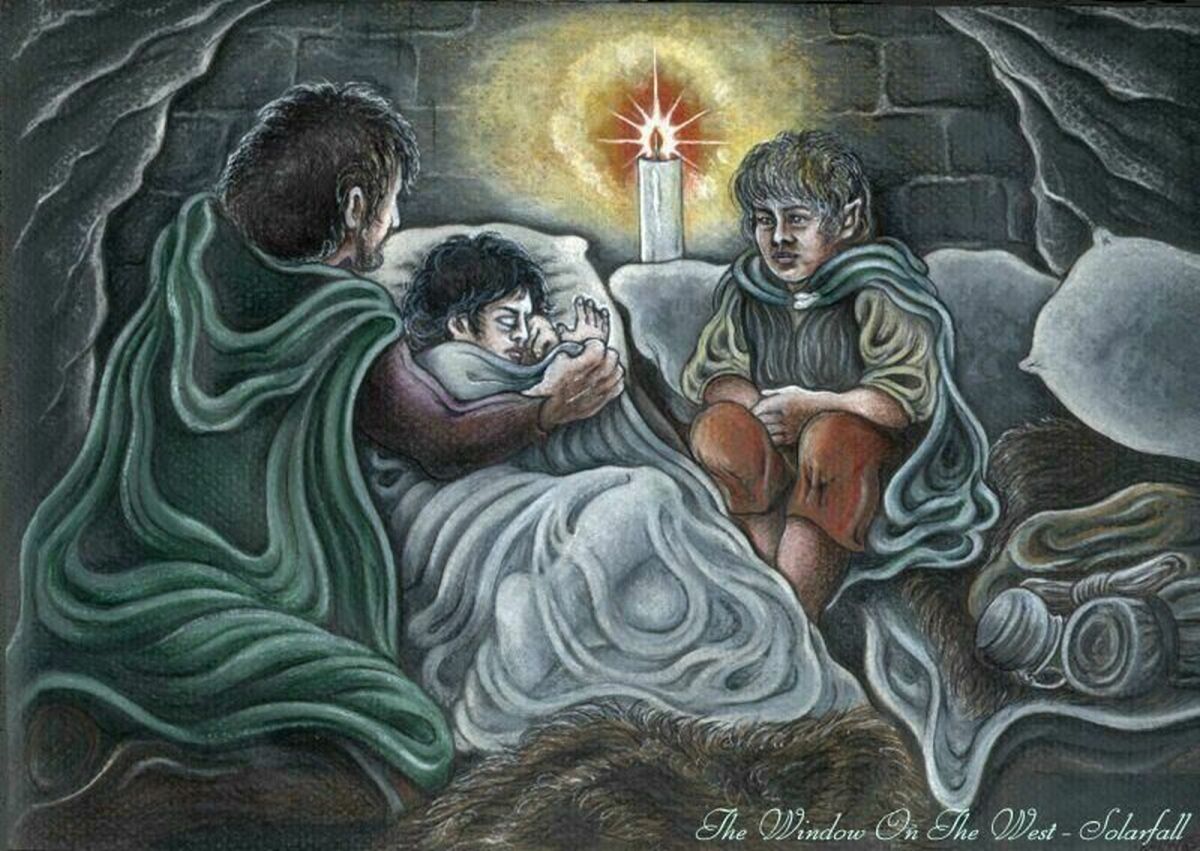
Captain Faramir shows his quality - ''the very highest''

But no peace is granted to Faramir; for now that Boromir is dead he must do the duty of two Captains and his father pushes him hard, often sending him to were the fighting is the worst because no one else will go. When he learns of the choice of his son to let the Ring go to Mordor he is filled with more bitterness towards Faramir and more sadness about the death of Boromir. ''Boromir was loyal to me and no wizard's pupil. He would have remembered his father's need, and would not have squandered what fortune gave. He would have brought me a kingly gift.''  What Faramir did - the magnitude of his choice and  the fact that he was able to do it - is lost on Denethor, who can only gripe on how foolish his son and Gandalf are for sending the Ring of Power into the land of the Enemy in 'the hands of a witless halfling.' He sends Faramir out again to battle, unthanked and unblessed, to rally the soldiers and hold the forts of Osgilioth against Sauron's advancing armies. The hobbit Pippen has grown to admire Faramir, and his impression of him is one of profound insight: 'Here was one with an air of high nobility such as Aragorn at times revealed...one of the Kings of Men born into a later time, but touched with the wisdom and sorrow of the Elder Race...He was a captain that men would follow, that he [Pippen] would follow, even under the shadow of the black wings [of the Nazgul].'
 A simple Hobbit sees in Faramir what his father does not, but can do nothing help him (yet), and all of Faramir's choices and inner victories are looked upon with scorn, contempt or indifference (even by some readers). The only use Denethor sees in him is that he is a man of war who can keep men from deserting their posts and retreating before he (Denethor) wills it. Faramir obeys the command of his father and again proves his quality on the battlefield, being the last to retreat when Osgiliath falls, fighting in the rearguard so the remnants of his men can get to safety. But it is not enough; he is attacked again by the Nazgul and mounted warriors of Harad and falls, pierced by an arrow, and is rescued in the nick of time by Gandalf and Prince Imrahil. ''Your son has returned, lord, after great deeds,'' the Prince tells Denethor. The Steward of Gondor looks upon his remaining wounded son and sees the folly of his decisions and the hopelessness of the War and gives in to madness and despair and Gandalf and Imrahil must take command of the defense of Minas Tirith.

Prince Imrahil tends the fallen Faramir on the battlefield

I sometimes dare to imagine what it must have been like to have been Faramir then: one moment you're fighting for your life against foes whose one desire is the destruction of your City and the slaughter of your people; the fell Nazgul are swooping above you, your men are braking rank and fleeing in panic, you are exhausted, suffering from the Black Breath and wondering, perhaps, that maybe your father is right and that to have sent the Ring to Mordor was a deadly mistake and you have failed and the world will burn because of it. Then the arrow comes, and the pain, and the black oblivion of unconciseness...

Some readers do not understand the nature (or purpose) of characters like Faramir. They seem to be in some sort of denial that such people can exist: the selfless, the patient, the obedient, the wise, the long-suffering, the ones willing to go forth and do what needs to be done, regardless of what happens to them or what others think of them. Faramir is too nice, to kind, to 'heroic' for some to handle. Maybe they are envious of these characters, because they themselves do not measure up; they lack the integrity, the will or desire to become something far better and then what they are now, to become holy, saintlike; godlike, and to maintain this manner of being in the face of all adversity, even when everything is against you. Nothing seems to be in favor of Farmir: his big brother is dead, his country is being invaded, he has been wounded when his people need him the most, and the end of the world is at hand. His father objects the things he loves (music, ancient history, Gandalf his teacher), scorns his choices, and sees him only as someone who can lead men into battle and delay for a time the day of doom (and even then he sees Faramir as the inferior one; Boromir was more of a warrior after all). Faramir is the last man left in Minas Tirith (apart from Imrahil) who can successfully rally and lead the soldiers to face Mordor's minions and he is the last in the line of Stewards. When he falls, Denethor falls as well, having no more hope for the future, and the whole City of Gondor is thrown into dismay and grief.

 Denethor mourning Faramir

Such is the power of the hero, the righteous man; such is the reliance and trust people have in them. Who would we have if we didn't have our heroes and saints? Just our own greedy, cowardly, self-centered little selves, with no one to look up to or be en-heartened by. God, what a miserable world 'real life' can be when it is stripped of - or in denial of - its Great Ones. Why else have so many of us hauled ass to Middle-Earth in one form or another since 1955? Or to Narnia? Or the abbey of Redwall and the fortress of Salamandastron? Novelist Stephen Lawhead hits the nail perfectly on the head when he writes that:

''...the best of fantasy offers not an escape from reality but an escape to a heightened reality...In the very best fantasy literature, like The Lord of the Rings, we escape into an ideal world where ideal heroes and heroines (who are really only parts of our true selves) behave ideally. The work describes human life as it might be lived, perhaps ought to be lived against a backdrop, not of all happiness and light, but of crushing difficulty and overwhelming distress.''

'Crushing difficulty and overwhelming distress' can be a good summery of most of Faramir's life until Aragorn calls him back from the shadows of death and heals him. And with the return of the King comes also the reward of the faithful Steward. Faramir lives, and not so he can just fight and fight and ride around with a sword, but so Tolkien can grant him his true heart's desire - and Eowyn's as well: to live the way they have always wanted to live, in enjoyment of those things they have secretly hoped for but where never able to attain while their people needed them to war against the evil ones. They have fought their good fight and did not flinch from the horror and the death and now that the new Age has dawned they can rest from their labors and be at peace.

The reward of Farmir and Eowyn: the new-found love for each other
and the enjoyment of the world they helped save.


Best Faramir Quote: 
(concerning war and peace)

''For myself, I would see White Tree in flower again in the courts of the Kings, and the Silver Crown return, and Minas Tirith in peace: Minas Anor again as of old, full of light, high and fair, beautiful as a queen among queens...War must be, while we defend our lives against a destroyer who would devour all; but I do not love the bright sword for its sharpness, nor the arrow for its swiftness, nor the warrior for his glory. I love only that which they defend: the City of the Men of Numenor...''


That's it folks, that is the reason to become a hero and save the world: so that the things, the places, and above all the people you love can be kept in (or returned to) their state of beauty, of peace, and blessedness - free from evil and tyranny. It is not the heroics that are the chief thing but that which they defend. The reason there are so many anti-heroes running around today is because people can't - or won't - find things, people, beliefs or values that are worthy enough to defend. But in Middle-Earth there are more then enough good things for heroes - big and small - to fight and die for, and we fans want to be always right there with them, even if we don't fully know it. Some understand this; many do not. I myself will be forever grateful to Tolkien for the fact that he understood, and brought us endless joy in understanding it with him.


Saturday, January 12, 2013

The Riddles of Aragorn # 3: Estel the Lover

 Aragorn and Arwen in Lothlorien

The Lord of the Rings is one of those odd books in which romance, love-triangles, explicit sex-scenes and tensions, debauchery, dirty jokes and forbidden/true love issues are not at all central or crucial to the plot of the story. There is indeed very little romance, no sex scenes, and no nagging woman around (with the possible exception of Eowyn) to trip the heroes up or get in the way of their tasks. This annoys a lot of people. It annoyed Peter Jackson, who preformed some serious character-assassinations (and made stuff up) in order to expand the love story of Aragorn and Arwen and make it more crucial in the movies. It does not annoy me; I actually like it. Here are my musings on Aragorn as a lover, the book romances and why they are important, and why Tolkien treated them the way he did.

In the book, there are only a few scenes in which Aragorn and Arwen are physically together. The first is at Rivendell in the Hall of Fire, where the Elves and the hobbits are singing after the celebratory victory feast held in honor of Frodo's recovery from the Nazgul wound. During the feast, Frodo noticed that Aragorn had not been at table, but he had beheld Arwen for the first time, seated close to Elrond, and Tolkien gives a lavish description of her as Frodo sees her, which becomes our impression as well, since we are seeing her through his eyes. Later in the Hall of Fire, as Fodo and Bilbo talk about their adventures together, Aragorn quietly comes in and stands looking down at them smiling. Bilbo looks up and sees him: ''Ah, there you are at last Dunadan!'' he says, ''...Where have you been my friend? Why weren't you at the feast? The Lady Arwen was there.''
''I know,'' says Aragorn gravely, ''but I often must put mirth aside. Elladan and Elrohir [Elrond's sons] have returned out of the Wild unlooked-for and they had tidings that I wished to hear at once.''
This reply is another important insight into the person of Aragorn. Up until this moment, Tolkien gave no indication that he was in a relationship, or that he might be in love with someone. This not-so-causal remark by Bilbo - who knows quite a lot about Aragorn - sheds a new light on the ragged Ranger Frodo has been traveling with for almost two weeks and adds another layer to the mysteries surrounding him. Later, as Frodo and Bilbo are about to leave the Hall, Frodo looks back and sees Elrond, Arwen and Aragorn all together: ''Elrond was in his chair and the fire on his face was like summer-light upon the trees. Near him sat the Lady Arwen. To his surprise Frodo saw that Aragorn stood beside her; his dark cloak was thrown back, and he seemed to be clad in elven-mail, and a star shone on his breast.'' Here, amide the enchanting elven hymns, Frodo (and us) are given a futuristic vision of Elessar the King with Arwen his Queen. They have already been betrothed, but still they must wait, for Elrond will not allow them to wed until the fate of the world has been decided and Aragorn passes his tests and takes up his rightful kingship of Gondor and Aranor

 Arwen at feast in Rivendell
Later, after Aragorn leaves Rivendell and journeys far away with the Fellowship, Arwen must continue to wait, for both of them have long-foreseen this war, and though their lives are long and such waiting can be endured, it is both weary and hard; and who in the end shall have the victory? The Heir of Elendil or the Dark Lord? So in hope and great fear she slowly makes for him a great kingly banner with Elendil's signs of the Tree and Stars and White Crown, which are the symbols of Numenor; the heritage of Aragorn. ''The days now are short. Either our hope cometh, or all hope's end. Therefore I send thee what I have made for thee. Fare well, Elfstone!'' And upon receiving this great gift, Aragorn uses it to declare  himself to the Oathbreakers; riding with it to victory at the battle of the Pelennor Fields and finally flaunts it before the Black Gates of Mordor itself. Arwen is a beacon of light and a quiet support to Aragorn during the War of the Ring, a light in his darkness, the treasure he will claim at the end of all his hardships, the hope of a new life lived in blessedness and peace with the one whom he most loves. Their love for each other is subtly woven throughout the story, shadowy but present, coming at last into full light after the crowning of the King. In the book Arwen never tries to talk him out of nor prevents him from doing any of his duties, duties which may lead to his death and the death of all their dreams; but she has hope, and so does he, and in the end they are victorious and their long waiting and labors finally come to fulfillment.

Then there is Eowyn, the Lady of Rohan. Eowyn has been tending King Theoden as he slowly grows weaker and sicker from the poisons and lies fed to him by Grima Wormtongue. She begins to sink into despair, musing on how inglorious her duties are and how her country and her people have fallen far from the honor and majesty they once had. After Gandalf heals Theoden he honors her by appointing her to be the guardian of the people of Edoras while he rides off to war. She leads the people to Dunharrow (not Helm's Deep) where they will be safe for as long as possible. But this is not what she wants. She has a fighting spirit to match her brother Eomer's but has no outlet to express it. For although her Theoden gives her a sword and armor her task is to defend, not fight. She becomes restless and agitated, for Grima has poisoned her thoughts as well. When she encounters Aragorn in the Golden Hall she sees in him a great leader, a 'tall heir of kings,' under no one's authority but the highest; a way out of the 'cage' she feels that she's in; a man with whom she could win great glory and renown far from her duties and her homeland.

 Aragorn and Eowyn at Edoras

Aragorn notices her, but not in the way she wants, for his heart's true love is for Arwen, and for her he has only pity for her situation, which he cannot alter. For although he is a king he will not go against the commands of Theoden and so forbids her from riding with the Gray Company, though she begs him, even if she does not approve of his choice in roads, saying: ''Lord, if you must go [to the Paths of the Dead], allow me to ride in your following. For I am weary of skulking in the hills, and wish to face peril and battle.''
''Your duty is with your people,'' he tells her. ''Did you not accept the charge to govern the people until their lord's return?''
Shall I always be chosen?'' she laments, ''But am I not of the House of Eorl, a shieldmaiden and not a dry-nurse? I have waited on faltering feet long enough. Since they falter no longer, it seems, may I not now spend my life as I will?'' This is somewhat ironic, because Aragorn, could he have his choice, would not even be on this road. ''I do not choose paths of peril, Eowyn. Were I to go where my heart dwells, far in the North I would now be, wandering in the fair valley of Rivendell.'' He does not seek the Paths of the Dead willingly, but because no other option is available to him. He is also under authority, and must do everything in his power to ensure that his kingdom does not fall. Both have duties to perform, and both must put aside their personal desires and do the deeds at hand before their own dreams can be fulfilled.
Again, Tolkien gives us an example of what it means to be self-sacrificial, and the importance of choosing
the right path, even if that path leads away from peace and love to great peril and possible death.

''But I often must put mirth aside.'' With these words that Aragorn speaks, Tolkien puts forward that he does not believe that love or romance or sexuality is somehow bad or inferior or dirty. What he does do is put these things in their proper place, within their proper context. Mirth and love will come, but not yet. There are more important things happening in Middle-Earth that require all of Aragorn's time and energies and these things take greater precedence over romancing and loving. This is why Tolkien put ''The Tale of Aragorn and Arwen'' into the Appendixes of The Return of the King instead of making it a chapter in the actual book. He felt if he made it a part of the main story it would distract/bog down the reader and draw attention away from the important events that were happening to the Fellowship during the War of the Ring. The doom of Middle-Earth hangs upon a thread and Aragorn must play his part as Frodo moves ever closer to Mount Doom, even at the expense of his own desires and wants. The same goes for Arwen too, and this, to me, makes their love story stronger not weaker; for at the end of the road, when all as been accomplished, Aragorn and Arwen, Faramir and Eowyn and Samwise and Rosie are well rewarded for their patience and endurance, using well their days far better then we who hunger for instant romantic and sexual gratification right now and to whom self-sacrifice, patience and purity are but old-fashioned ideas from a irrelevant age. Not so in Middle-Earth, where the Queen and King of Gondor reign in glory, and Sam plays in his garden with his children, and Eowyn finds love and contentment at last in the kind arms of Faramir. It was well-worth waiting - and fighting - for.  
   
 Peace at last: King Aragorn Elessar with Queen
Arwen Evenstar

''Use well the days.''

Tuesday, January 8, 2013

In Praise of the 'Good Guys': Defending the Virtues of the Heroes in 'The Lord of the Rings'


 Frodo the Ringbearer

This post is an expansion of a reply I gave in the LOTR book-to-movies character-assassination forum 
that I started recently on Fanfiction.net. I had been lamenting the fact that in the Peter Jackson films just about every main character is stripped of almost all the personal, powerful and heroic qualities/moments Tolkien graced them with. Soon enough, someone replied that what works in books can't work in movies (which is why words will always trump film) and that characters need weakness in order for us to identify with them, and that they (Aragorn, Elrond, Frodo, etc) can't be perfect. That got me thinking about 'perfection' and what is means to be 'good' and the result was this musing:

I will first talk about 'perfection'. To be 'perfect' (as understood by most people now-days) is to be someone who is always right, never wrong, makes no mistakes, is flawless, and never derailed by anything - with a good moral compass to boot. Because none of us except Christ Himself can make the claim to be totally perfect we wouldn't want to read about people like that because that would exclude us. Being moralistic (always obeying the law and doing everything the 'right' way) is actually a bad thing - when always 'being right' starts to trump mercy and compassion and love then it becomes a sin.


Are Aragorn, Elrond, Frodo and the other defenders of the West 'perfect'? Actually, they aren't. Instead, Tolkien bestows upon his heroes something other then perfection, something far better (although to the untrained eye and heart these things can often be confused with being perfect), Tolkien gives his protagonists virtues: Love, hospitality, courage, compassion, loyalty, peacefulness, integrity, bravery (sometimes taken to quite an extreme level), mercy - and in the book it is mercy - or rather pity - that is the thread upon which the fate of all of Middle-Earth is hung.


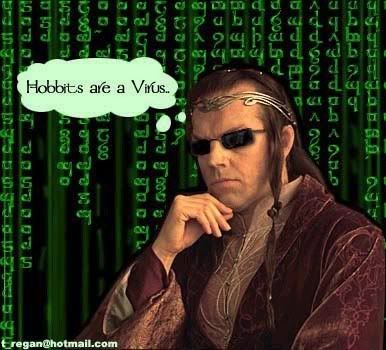
We love Elrond Halfelven not just because he's an ancient warrior badass, but also because he is kind and gentle and meek. Is he dangerous? Absolutely. Is he powerful? Without question. Can he mean? Angry? Can he treat the Men and Dwarves and Hobbits and the non-Noldor Elves who come to him for counsel, aid and healing with the same regard as the dirt under his feet, too good for him even to look at? Yes, he can, he possesses free will after all; and if he desired to behave like this towards others, he could (or if Agent Smith steals his cloths and his house and pretends to act like him = fail).

But does he actually behave like this in the great tale of the War of the Ring that we all love so much? He...does...not.


And there lies the secret of virtue, the mystery of holiness, the beauty of the 'good guys' that Tolkien has made for us. Elrond (I'm using him as the main example here) is immortal and powerful, mighty in battle and skilled in healing and very wise, but how does he behave? That is the ultimate key. How does he treat others who are below him in power, wisdom and strength? How? He is kind to them, he heals them and advises them; he protects and shelters them in his fortress/home - the Last Homily House east of the Sea - where time seems to slow down and all grief and weariness and fear are lifted from their hearts. Tolkien doesn't just describe Elrond as being noble and great - Elrond himself confirms Tolkien's words by his actions and deeds - deeds which range from fighting in the Last Alliance for seven years, to helping a frustrated Thorin understand his map, to allowing an aged Bilbo to stay in Rivendell for as long as he likes, even though Bilbo is just a small Hobbit and compared to Gandalf and Glorfindel is very small in terms of power, wisdom and usefulness. 


 Three of the Immortals: Gandalf, Elrond and Glorfindel

Elrond's hidden realm, Rivendell (as well as Lothlorion), is itself a kind of paradise: a blessed valley where evil things will not come. Once you have reached it you find it very hard to leave. You are safe there, in the company of beings who are not in it for themselves; that are not going to hurt you, or lie to you or steal from you or slander you. There you will rest, and be healed of your hurts and sorrows. And there you will hear hymns and songs about the Blessed Realm and tales about the mighty heroes of old. You will feast in the company of the real Immortals and maybe attend (or sneak into) a secret Council in which the fate of the world is discussed. You are safe there, safer perhaps then you are among your real family in your real home. I myself have been in the monastery/house of a kind and holy monk and can confirm it by my own experience: I was safe, I was loved; I did not want to leave; I was showered with hospitality and gifts that I had no right to receive but were shown and given to me anyway, and not because I had anything to offer. 

Aragorn grows up in Rivendell, in this kind of atmosphere; and when he leaves to wander Middle-Earth and struggle against Sauron he takes these virtues with him and gives every good thing he has to ensure the safty and survival of four clueless Hobbits who have no idea what they're in for. He becomes a hero to them, and they in turn his friends, for whom he would pursue to the ends of the world to rescue, even if it means starving in Fangorn or getting killed by the Rohirrim and never returning to Gondor or marrying Arwen.


 Captain Faramir also displays great wisdom and bravery and kindness. And although Boromir falls, he repents and dies a good death, laying down his life for two beings he never knew existed until a few months ago. King Theoden is very kind and condescending, with an appetite for Hobbit-lore that few others (including many readers) seem to have. If it hadn't been for his death in battle he would have sat in his Golden Hall in Edoras and listened to Merry and Pippen talk all day about the Shire and the ways of Hobbits and would have not thought it beneath his dignity to do so. I could go on and on, but what I'm trying to say is that it's not about being 'perfect'; it's about being righteous: of being merciful and brave and willing to give of yourself - like the Rangers - so that others - whether they know it or not - can be happy and free from evil and tyrannic beings; even if it means dying.


 Boromir defending Merry and Pippen

In the end - or at least one of them - The Lord of the Rings is about becoming a hero and saving the world. And when I think about it, there is no other story that can top that; not one. And Tolkien has given it to us in its finest, most grandest form, which is why I love both it and him. Tolkien himself wasn't a 'perfect' person, but that didn't stop him from believing that true heroes are real and that ordinary mortal people like us can become like them, or at least aspire to. After all, saving the world can be a long and hard and messy business, and not all heroes make good choices or go on to good ends. Some of them return home only upon their shields (or in elven boats) and yet there is always someone there - someone they saved or whose lives they enriched in some way - to sing their lament, to state that their lives and trails and sacrifices weren't all in vain; to cry: 

''Out of doubt, out of dark, to the day's rising
he rode singing in the Sun; sword unsheathing.
Hope he rekindled, and in hope ended;
over death, over dread, over doom lifted
out of loss, out of life, unto long glory.''

(funeral song for Theoden; The Return of the King)


 Theoden-King, Lord of the Rohirrim

''And in hope ended.'' What is hope? Who gives hope? Whence comes hope? Why do some have it and others do not? The deaths of Theoden the King and Denethor the Steward are a study in two completely opposite - and opposing - worldviews: that of the Defiant Hero and the Despairing Defeatist, both paths freely chosen by each. Theoden has the choice of not going to aid Gondor, to not charge into the Pelennor Fields were death seems to await all, yet he does so regardless - ''Ride now to Gondor!''- defying both death and despair, and in doing so he achieves immortality in the hearts and memories of all those who come after - including the readers: remembered as ''a gentle heart and a great king who kept his oaths, and he rose out of the shadows to a last fair morning." King Theoden has hope, even though the battle appears hopeless and that the armies of Sauron will have the victory, and he and Merry and Eowyn and Eomer confront doom and defeat head-on and in doing so are made worthy forever of their 'long glory'.
The Steward Dethathor, in contrast, has no hope - being deluded by Sauron and filled with pride and despair  - and does not wait for aid or healing or the news at the coming of the dawn, but taking Faramir with him he goes to the Tombs of the Kings and there a pyre is built upon which he will burn himself along with his wounded son. ''Why should we wish to live any longer?" he challenges Gandalf, ''For thy hope is but ignorance...Go forth and labor in healing! Go forth and fight! Vanity...against the Power that now arises in the East there is no victory. The West has failed!'' So he burns alone on his pyre while Theoden dies with his knights on the fields of Gondor, and the hearts and beliefs of those who possess hope and courage and love verses those who do not, or who reject them, are laid bare by Tolkien for all to see - and to choose between.

For it is the choices that the heroes make during the War of the Ring that are the most defining thing about them. Some have accused Tolkien of not developing his characters enough and maybe this is somewhat true, but what I have noticed as I read and reread The Lord of the Rings that the 'character-development' (which I prefer to call 'character-revelation') is extremely subtle - almost invisible, like when one is wearing the One Ring, but still there. The problem is is that many of the big, bold 'heavyweight' characters like Theoden and Elrond and Aragorn have already spent decades, centuries and Ages 'developing' in the wings. When we (through the Hobbits) encounter them for the first time, we are seeing them at their height of development and person-hood, ready to take on the challenges, destinies and duties placed before them - which is what they have been doing the whole time. It is the Hobbits that go through the most noticeable character development, for the events of LOTR are almost entirely seen and related from Frodo's, Sam's, Merry's and Pippen's eyes; the eyes of the smallest, most 'normal' people finding themselves entangled in events beyond their comprehension with beings out of myth and legend that they never expected to encounter.


 Samwise the Hobbit attacking Shelob

Again, is is the choices the characters make and the deeds they do that are perhaps where the most character-revelation lies, and were their virtues and goodness shine. With one spoken sentence, one gesture, one act, Tolkien tells us more about his heroes then dozens of pages of inner angst-ridden ''I'' point-of-view stories that has have flooded into literature. Encountering Tolkien's people is almost a relief to me because there are things about them that I don't know, that aren't explained, that don't make it into the story. Aragorn, Frodo & Co are allowed to have some privacy within their own beings. They are not psycho-analysed, their thoughts and feelings and opinions are not laid compleatly bare for all to see; many aspects of their lives - including their histories - remain a mystery. And I am glad of it. Who am I after all to think that I can know everything about a person in a story when I cannot ever know the inner thoughts and feelings of the people I love the most? whom I  'know' the most in real life? Vanity. And there's the fact that despite the perceived lack of 'character development' readers world-wide have fallen in love with Tolkien's heroes and voted in many different polls The Lord of the Rings as the ''greatest book of the century'' (and this was before the movies came out). Very telling, that. And why? Because, quite honestly, in Tolkien's world the heroic is celebrated; the home that you love is protected and fought for as a place that has meaning and value; the enemies who want to destroy/enslave your people are defied and resisted at all costs; your neighbors and friends are reveled as 'lords of great dignity and power;' your struggles become their struggles; their victories become your victories; and there is mystery and magic and wonder and the glory of the goodness of the good that makes you want to enter in and remain there for as long as you can so you can experience it to its fullness.

The honoring of Frodo and Sam - ''Praise them with great praise!'' - on
the Field of Cormallen by the Captains of the West

And finally, Tolkien has given to us something that very few authors have managed to do in a believable, meaningful manner; for many authors indeed write about Evil and death and despair and glory in the 'realistic' Grim-Dark of the world, and Tolkien is no exception. But he offers us something more, something that rises him (and us) up above the shadowy clouds of Mordor and the bloodied fields of the Pelennor and sets him (and us, if we allow it) on that high mountain-top in Valinor where the Light forever shines: Tolkien gives to us, in the world of Middle-Earth, a vision of that strange and hard-to-depict virtue of them all: Joy. 

Tolkien gives us Joy:   ''a fleeting glimpse of Joy, Joy beyond the walls of the world, poignant as grief.''*

All the protagonists in The Lord of the Rings have this virtue, some more then others, some more potently seen and expressed then others, and it runs mysteriously throughout the book like a secret underground spring that sometimes erupts out into the open like a geyser shooting into the air, its spray glittering in the sun, combating gloom and despair (of which there is also a great deal of as well). There is a collective joy, such as in the Hall of Fire in Rivendell where the Elves (and certain hobbits) sing and tell stories about the first Ages. There is personal moments of joy such as when a despairing Eomer sees the black ships of Umbar coming up the Anduin and thinks his doom is at hand and then he sees Aragorn's banner of the Tree and Stars flow out from the topmost mast and realizes that the King is come and hope is renewed. Old Tom Bombadil is Joy personalized; the Shire is a shelter and haven for joy as must of us know it, small and simple, taking delight in the ordinary stuff of life like beer and smoking, while in Lothlorien the joy is beautiful, tragic and yearning, bordering on the holy and terrible. And everyone finds a way to express it: they sing, they dance, they cry, they hold feasts and parties and exchange gifts. No one is ashamed of showing it, from the mightiest of Elves to the smallest of Hobbits. 


Elves singing in the trees at Rivendell

I think that is the greatest reason why Tolkien's world is so beloved and sought after. The joy, the triumph, the exaltation we feel when we're riding with the Rohirrim or seeing Gandalf returned from death or beholding the Black Gates of Mordor falling in ruin or facing off with a Balrog or laughing at the antics of twelve Dwarves singing and cleaning dishes at Bag Eng or wandering through fair Lothlorien as if we were in a lingering shadow of Paradise or just walking with Frodo and Bilbo under the stars in the Shire (hoping to see some Elves) - these things are not just enjoyable, they are good for us. When we leave the book we are not the same. Our souls and our hearts have been fed as well as our imaginations. Maybe we are better, healed a bit more from our sickness and grief, finding at last something true and beautiful to love and treasure.
Yes, Middle-Earth is also a very dark and deadly place, for the schemes and lies and wars of Morgoth and Sauron have made it so; but no one can overturn the desire of Eru, and the Lords of the West still sit enthroned in Valinor and ''above all shadows rides the Sun'', and the heroes and saints of Arda laugh and love and weep and fight and die without once caring whether or not  it makes them too 'perfect' or too 'good' or too 'heroic'. Such triviality is beyond them; they are fixated on one thing: 'to do the deed at hand' - be that deed to arrange a birthday party in the Shire or to defy a Balrog in Moria - they do these deeds with the same fierce passion, the same unbreakable determination and the same uncompromising love and duty to 'lord and land and league of friendship.' For so their Sub-Creator has willed it, and so they are; and there they will abide, undefiled, in that Middle-Earth, those true heroes and champions of the Good 'unto the ending of the world.' 


* From ''On Fairy-Stories'' in The Tolkien Reader by J. R. R. Tolkien


Monday, January 7, 2013

The Riddles of Aragorn # 2: Aragorn The Leader

Aragorn leading the Gray Company and the Shadow Host
through the Paths of the Dead.

''Not all who wander are lost."

Although it can be sometimes hard to spot, there is a difference between being chosen to be a leader, and always seeking to be a leader. Aragorn falls into that rare category of men who, although he is a leader, does not often put himself forward as one, letting the people (whether it be Frodo or King Theoden) decide if they want his aid and skills or if they do not. Even though he is a mighty warrior and has many decades of well-honed survival and leadership skills he rarely flaunts them openly, preferring to be wanted and loved for his own sake and not just because he is good with a sword or can lead fearful men into hellish places and battles.
This is the second main reason why he rejects Eowyn's advances towards him: he knows she does not love him for himself (indeed neither of them hardly knows the other at all) but rather the glory and the power that surround him, and the greatness she could achieve by being with him, instead of always serving her King and guarding the people of Edoras.  After he heals her in Gondor, he says to her brother Eomer: ''Eormer, I say to you that she loves you more truly then me; for you she loves and knows; but in me she loves only a shadow and a thought: a hope of glory and great deeds, and lands far from the fields of Rohan.'' Ages earlier he told the suspicious Hobbits in Bree: ''...I must admit...that I had hoped you would take to me for my own sake. A hunted man sometimes wearies of distrust and longs for friendship.'' This is Strider the Ranger speaking, and to the hobbits he resembles a vagabond and a thug; his looks are against him because of his many hard journeys, and there is nothing kingly or noble about him when they first meet.
After Gandalf falls in battle with the Balrog in Moria, Aragorn takes up the leadership of the Fellowship, though he is neither pleased nor happy with this turn of events. Here Tolkien allows him to express some of the fear and doubt he has and the internal agony he goes through over choosing which way to go and who to follow after the Fellowship is broken. Even after be becomes leader, he never simply orders the rest of the Company around like he does in the movie; he allows everyone to voice their thoughts and opinions and listens to them before making a final decision.

 Aragorn, Legolas and Gimli on their way
to Minas Tirith via the Anduin river

But as the War of the Ring heats up, Aragorn knows that his hour is coming and slowly his behavior begins to change: he becomes more assertive, more direct and firm in his choices and paths. He slowly leaves his quiet background Ranger mode and starts acting like who he truly is: a leader and a king. Still, he never directly commends anyone to do what he wants, everyone who follows him or does anything for him does so out of their own free will, because, as a heartbroken Eowyn tells him: ''They love thee.'' which is what he wants most of all: to be loved for is own sake and not simply because he is a great warrior or a king. It is the virtues within him that draw people to him, and when sword-skill and leadership are added to this, then Theoden and Eomer and their people know that here is a man who will do everything in his power to fight with them against the treachery of Sauruman and the malice of Sauron. And he does. The chapter ''The Passing of the Gray Company'' in The Return of the King is the most telling one about the kind of person Aragorn is, not only by his words but in his deeds, and the testimonies of those who encounter him. And when he enters the Paths of the Dead, none of the Elves or Rangers or horses or even a terrified Gimli himself turns back. As Gimli tells Merry and Pippen afterward: ''Upon that road I was put to shame: Gimli Gloin's son, who had deemed himself more tough then Men, and hardier under the earth than any Elf. But neither did I prove; and I was held to the road only by the will of Aragorn.''
''And by the love of him also,'' said Legolas. ''For all those who come to know him love him after their
own fashion...In that hour I looked upon Aragorn and thought how great and terrible a Lord he might have become in the strength of his will, had he taken the Ring to himself. Not for naught does Mordor fear him...for is he not of the children of Luthien? Never shall that line fail, though the years lengthen beyond count."

Aragorn with Anduril

After the victory at Minas Tirith, Aragorn, Gandalf, Eomer and Prince Imrahil lead the final remnants of the armies of Gondor, Rohan and Dol Amroth to the Black Gates of Mordor in a great suicidal attempt to cause Sauron to empty his land and unleash the rest of his hordes upon them so Frodo and Sam can reach the Cracks of Doom and keep the Eye turned away from them while they are still alive. Aragorn and the other lords know full-well the irony and folly of this final move: that even if Frodo should destroy the Ring they might all be slain in the meantime in the battle before Mordor's walls.
''As I have begun, so I will go on,'' Aragorn tells the assembled Captains during the last debate. ''Nonetheless I do not yet claim to command any man. Let others choose as they will.''
Again, Aragorn sets aside his right to to command as King, allowing once more others to make their own choices without force or compulsion. None of the Captains refuse to turn away from the deed at hand
but in this dark hour, when 'hope and despair are akin' not all the soldiers from Rohan and Gondor can
bring themselves to go on to the end, for 'these were young men from Rohan, from Westfold far away...
and to them Mordor had been from childhood a name of evil, and yet unreal, a legend that had no part in their simple way of life; and now they walked like men in a hideous dream made true, and they understood not this war nor why fate should lead them to such a pass.' Aragorn is filled with pity rather of anger at their plight and dismisses some of them to go and hold other places against Sauron while the rest march on. They arrive and challenge the Dark Lord, and the Mouth of Sauron mocks Aragorn, saying: ''Is there anyone in this rout with authority to treat with me?...Not thou at least! It needs more to make a king then a piece of Elvish glass, or a rabble such as this. Why, any brigand of the hills can show as good a following.''
Aragorn says nothing to this 'Black Numenorean' but taking the Mouth's eye he shows his power by assaulting the other mentally, perhaps (in my view), showing him an image of himself as he could have been, even as Aragorn secretly is, if he had not renounced his heritage, his faith and history so he could
be Sauron's most trusted Lieutenet; the ambassador of the Dark Tower.
But in the end, the Captains of the West reject the Mouth's terms and the temptation to despair and make ready for their last great battle. The hosts of Mordor surround them and 'fair and desperate was raised the banner of the Tree and Stars' and Aragorn stands beneath it, 'silent and stern, as one lost in though of things long past or far away; but his eyes gleamed like stars that shine the brighter as the night deepens.' Here is where all his struggles and hopes come to an end-point and no more can be done by any of them except wait on the Ringbearer; and he along with Gandalf, Merry, Legolas, Gimli and all their faithful allies prepare to fight to the last, awaiting the final stroke of doom.

 Aragorn at the Black Gate of Mordor

Thus they follow him, even to their own deaths, not because he orders them to, but out of love for him and for Middle-Earth; because he will not fail them; because he is not in it for himself; because he is a real hero - not an anti-hero, not a self-hating/doubt-infested hero full of angst, but the kind of hero no one hardly writes about (or believes in) any more: self-giving: saintly and kingly; more moved to pity then anger, more merciful then judging; fierce in battle and a healer to the suffering; a 'vision of the splendor of the Kings of Men in glory undimmed before the breaking of the world.'


To be continued...