Middle-Earth: A World Worth Fighting For
Showing posts with label heroes. Show all posts

Thursday, April 25, 2013

Why Tolkien's Works are 'Racist' - and Why that's a GOOD Thing for White People


(Sloaney is now going to tackle some VERY touchy subjects. This will probable be the only post in
which I bring up politics, current affairs, love for homeland, racism  sexism, belief in traditions and
country, and the need for Borders, Language and Culture, but I think this needs to be done. You might
be offended. You probably will be offended. I'm not sorry. I'm tired of my kin and I having to apologize
for all the evils in the world - or at least in my homeland of America - and that we [the white Anglo-
Saxon race] are responsible for them all. Total BS! The views expressed in this post are my own and I
don't expect many readers to understand or share them, but I will write of them nonetheless. This post
will be long - and even after I 'publish' it I will still be adding to it - and meandering. You have been warned.)

Please also note: In this post, whenever I use the word 'we' I am using it to mean myself and my race:
those of white American/English-Anglo-Saxon/Germanic/Danish/Swedish decent and their near kin.

*   *   *


 They are not ashamed. Neither am I

If there are three unforgivable 'sins' that a white person can never be absolved from in our current
society today, these three sins would be these: Racism, Sexism and Traditionalism. Any white
person that is found to hold or partly hold any of these 'isims' as part of his belief system is considered,
in the eyes of his kinsmen, worse then a rapist, a murderer and a pedophile. If said person also has Conservative political leanings, is a follower of Christ, passes on traditional wisdom to his children and
keeps a number of weapons [guns!] in his house because he honestly believes that his house is his castle
and that those that dwell within must be protected from outside invaders - commonly known as robbers, rapists and murderers - he is considered even more vile and dangerous. This would be me (mostly), and
the parents (for a time) who raised me.

J. R. R. Tolkien has been accused on and off of all three of these 'sins' in his works, mainly of Racism (his Traditionalism is often attacked too, although that word is rarely used. When you come across people or posts attacking the hierarchy, patriarchal and misogynistic elements in the cultures in ME they are attacking his Traditionalistic world-view).
Some of these written accusations are extremely nasty and sickening to read (this quite a disgusting rant;
you have been warned) while others are full of snooty modern superiority (I did think this was kinda
funny though). Like this Vedare article says: you can't make this stuff up. Or this.

So what am I going to do? Grab my sword, mount my horse (yes I have a horse) and ride off to join
the Free Peoples of the West in the defense of their Sub-creator? Yes, I am, but not in the way you
think. I'm not going to argue here that Tolkien wasn't a racist (in that he hated non-white peoples and
that he deliberately wanted his readers to hate them also - Tolkien himself would have never allowed
himself to hold these views - he despised racism of that kind; he even accused 'that ruddy little ignoramus Adolf Hitler' for 'ruining, perverting, misapplying, and making forever accursed that 
noble northern spirit, a supreme contribution to Europe, which I have ever loved, and tried to present
in its true light.'), I am instead to try and point out that the perceived racism in The Lord of the Rings is
not an attack against people of color but a celebration and a praise of Tolkien's own people (and
mine) - the English Anglo-Saxon race and their near kindreds. To put it in blunt and very unpoliticaly
correct language, LOTR is an epic saga written by a man who was not ashamed to be white. It
was written by a man who loved his people and who loved the myths, legends, languages and traditions
of his people and those similar to them. Tolkien felt that the English people had been robbed of their
proper myths and/or had had outside myths mixed in with them by foreigners and had very little to call
their very own. The whole legendarium of Middle-Earth is nothing short of Tolkien trying create (or rediscover) the mythology of England, his beloved country. It was written by an Englishmen, in honor
and praise of English/Anglo-Saxon culture, myths and traditions - in short, this is a white man's tale; something we ourselves can truly call our own (not that this has stopped other races and other cultures
from enjoying it as well).

 Earendil the Mariner: one of the first and most
important figures in Tolkien's mythology

Awkward-sounding is it not? Anyone grimacing yet? Before
I go on, I suggest that any people of color (none-whites) who might be reading this post out of curiosity should maybe
stop now. They might get offended or they might find the
rest of this musing irreverent to them since I will be talking about white people and * gasp* white 'pride' (yes, there is such a thing, as I will show). I am not a 'hater' and I am not trying hate or encourage hatred on people of color; I am
trying to show my own racial pride (not be be confused 
with racial superiority) and defending my own race by defending Tolkien and the white peoples and cultures he created for Middle-Earth, namely the Lords of the House
of Eorl, the valiant Rohirrim.

So here are the big questions: Is Tolkien a racist? [or rather, do some cultures of people in ME dislike being invaded by strange cultures who do not have their best interests at heart?] Yes. Is Tolkien a sexist? [or rather, are woman portrayed more respectfully and honorably, and treated better by the menfolk in ME then in other fantasy worlds?] Yes. Is Tolkien a Traditionalist? [or rather, do the peoples of ME show respect and honor to their worthy kings and rulers and fight to preserve the traditions of their respective cultures?] Yes.

As a Tolkien fan and as someone who reads his books often and extensively, I declare him guilty on 
all three of these accusations. And this is a good thing. Yes, you read right, this is a good thing. Please
read on...

So, yes, Tolkien can truthfully be accused of racism - and he is accused of it by both people of color
and by white people who have been taught to be ashamed of their own race and heritage. When the
Peter Jackson film adaptions came out there was an even greater stir because while two of Tolkien's
other sins - Sexism and Traditionalism - had been dumbed-downed and glossed-over, the racial sin
was allowed to remain - no black actors where incorporated into the films, there were no black hobbits, elves or men to be seen, and the people of color - the Southrons and Haradrim - where kept in their
proper antagonistic roles.

 Movie-version: The Riders of Rohan take on the Haradrim invasion force
during the Battle of the Pelennor Fields

And as shown by the articles already linked, some people took (and still take) offence at this, whether
they read the books or watch the movies (this one is just plain idiotic). Why? We have been taught
(especially if we're American and went to public schools) that as white people we are all 'guilty' of just
about every racial woe from the beginning of time.
We must be always apologizing to blacks and other people of color for all the racial sins and crimes of
our forefathers  If we happen to be wealthy, well-educated or live in a nice neighborhood we must feel
even more guilty. Our heroes and founders, like George Washington for example, are slandered and
hated upon and we are not allowed to defend them or even admire them at all. We are taught that there
is nothing good about being a white person, and that we have no history or heritage or culture that is
good or worthy of praise. As a race we are forbidden to have a racial identity or pride, while Negros,
Hispanics and Asians are praised for having strong racial ties and for taking pride in their people and
their cultures. If we attempt or desire to live in segregated and humongous communities with people of
our own race we are called  racists and 'over-privileged whites' and if we try to start groups we are considered Klu-Klux  Clan members or Aryan Supremists. There are dozens of racial insults that are
heaped upon us by other races (cracker, white trash...etc) without shame and if we take offence or
retaliate then our case grows only worse. Thanks to Hitler, we are forever going to be considered
neo-Nazis whenever we group together or stand up for shared interests.

The country of America which our ancestors built for us is under attack, and our corrupted
government, instead of shutting down our boarders and attending to the needs and interests of its
own people, encourages the continuous in-pouring of various immigrants, many of whom are not at
all interested in learning our language  respecting/adopting our culture, and acknowledging our borders
or laws (not that all immigrants take advantage of us and feed off of us, but there are currently far to
many who do so, and it takes a heavy toll on our institutions and resources). Instead we are expected
to cater to their every need with our hard-earned tax money and not be offended when some of them
fly the Mexican flag above the American flag or when others blow some of us up at running marathons.
We are told to be tolerant and welcoming of such people, and that 'diversity equals strength'. We are
told in so many sublimal ways to shut up, feel guilty, hand over our guns, pay taxes, and never take pride
in the fact that we are white Americans living in a land that was created for us. And we comply. But not
all of us. Some of us aren't ashamed, and we morn our racial and cultural deaths.

So why should we love the 'racism' that is constantly complained about in Middle-Earth? Because in
Middle-Earth race actually mattersLanguage and culture actually matter. Borders matter. Look at
any map of Middle-earth and you will see the designated names and homelands of many different kinds
of people were each one maintains their own unique culture and way of life that suits best their race and needs. The Elves have Rivendale, Lorien, Mirkwood and the Gray Havens. Men have Gondor, Rohan, Bree, Dunland, Dale, Dol Amroth, Umber and near/far Harad. Hobbits have the Shire, Bree and
Buckland. Ents have Fangorn forest. Dwarves have Moria, the Lonely Mountain and the Iron Hills.
Sauron has Mordor (and wants everything else). Orcs, Balrogs and dragons have mountains to hide
and plot in. The Lords of the West (the Valar) have Valinor. The departing Noldar (the High Elves) have
Tol Eresse. Even singular beings like Tom Bambadil and Shelob have their own lands and life-ways that
they guard and maintain. In Arda every being, good or evil, mortal, immortal and supernatural have a 
place, a ruler and a hierarchy.

All the species/races of beings in ME have their own languages, cultures and homelands. Some are
bigger then others. Some are more advanced and sophisticated then others. Some are more pleasant
and beautiful then others. Yes, there is great 'diversity' in Tolkien's world, but that diversity is maintained because each race of being live humongous with others of their own kind who share the same cultures
and traditions and way of life. Gondor and Rohan may be allies and friends with each other, and may
visit, lend aid, give gifts and on occasion marry one another, but you don't see any cultural mingling, no forced integration. No herdsman of Rohan graze their horses on the grasses of the Pelennor Fields and
no Stewards of Gondor build Orthanc-like star towers in the middle of the Courts of Edoras. The same
goes for all others. Hobbits do not travel en mass to the Gray Havens and sail Cirdan's swanships up
and down the Firth of Lune (although that would be an amusing sight). Ents don't come striding into the
Shire and then complain that they can't enjoy a mug of ale at the Green Dragon because they can't fit through the door. Among the 'good' cultures 'racism' - the desire to live with one's own kin and to
show loyalty to one's own ruler - prevails over the desires and viewpoints of outsiders. When Aragorn
balks at having to leave his sword Andruel outside of Theoden's Golden Hall because the laws of the Rohririm say that strangers are not allowed to come before the king baring weapons, Hama the
Doorguard reminds him that even if he were the ruling King of Gondor he still cannot go against the
will of King Theoden because Aragorn is in Theoden's kingdom now and he must abide by the laws of
that king and people, whether he likes them or not. Gandalf backs Hama up by saying, ''A king will have
his way in his own hall, be it folly or wisdom.'' In ME to disregard or scorn the laws of other peoples and cultures runs the risk of strife and death. However, Gandalf later tells Theoden that the ''courtesy of your
hall has lessened of late.'' This brings up the point that while 'natural racism' (if I may call it that) is one
thing, it is quite another thing to withhold hospitality and aid from honest, nonthreatening persons in need
of help or council. This is where 'racism' (in the way I've been showing it) becomes indeed the much
reviled and despised sin of the modern world today, for when a person or a group of persons 
becomes so self-centered and isolate themselves willfully from the rest of the world and 
refuse to do any good to outsiders that come to them out of need, then this natural desire 
to be with one's own people becomes a sin and a vice, and its practitioners selfish, arrogant 
and hard-hearted. The members of the Fellowship of the Ring travel through many different kingdoms
of Men and Elves and whenever they cross the borders of these lands the natives are soon aware of it
and they naturally desire to know what these outside people (or persons) are doing in their lands. After
they find out the nature of the Fellowship it is then to their credit or discredit whether they decide to give
or withhold aid and advice - yet it is their right to hinder or help as they deem fit, in accordance to their
laws and free will.

 Haldir the Elf guides the blindfolded Fellowship into the the depths of Lothlorien

As long as all peoples of Middle-Earth respect each other's languages, borders and cultures there is
peace in this otherwise very diverse world. But not all peoples/species do so. The Dark Lord Sauron
does not care about borders, languages and cultures. He does not respect them or honor them. He wants
to conquer them and subjugate and own them. He wants to tyrannize the Free Peoples of the West and render their homelands and ways of life obsolete. He desires that he should be their god and they his
helpless slaves.
The Elves and the men of Rohan and Gondor and certain Hobbits are not at all open or accepting of
this fallen Maiar's designs. The Council of Elrond is assembled (though not by Elrond himself), Frodo
volunteers himself to be the Ringbarer and the great War of the Ring is begun, a war in which the
'good guys' fight to preserve their rulers, kingdoms, cultures and traditions against the 'bad guys:' orcs
and strange-looking Men from strange far-off lands who are disregarding their boarders and invading
their territories with the intent  to plunder, kill and destroy them and their cities. What makes this
otherwise very understandable situation so offending and unforgivable to many modern readers/viewers
is that the people doing the attacking are people of color and the people are trying to defend themselves
are people of fair white skin; in other words, people of Tolkien's own race (and subsequently my own). Tolkien could have easily written it the other way: where Sauron corrupts the leaders/governments of
Rohan and Gondor and through fear or the promise of power gets them to send their armies hundreds of miles from their homes to go and destroy those annoying Haradrim and Southrons away in the East who don't want Sauron to rule over them. If Tolkien had written LOTR that way, modern readers would 
be applauding the book today as an allegory of colored minorities triumphing over the cruel 
white invaders. But...

 King Theoden is the bomb!

...that is not how Tolkien wrote the story. In The Lord of the Rings it is the white Angelo-Saxon
type of people who have their day of glory in the sun - from the elderly King Theoden of Rohan and
Eomer his sister-son who stick to their oaths and lead their golden-haired Riders to battle and death to
aid and defend their brethren, their 'league-fellows' of Gondor to King Aragorn himself, who arrives
un-looked for in their darkest hour during the Battle of the Pelennor Fields, revealed now as the true
King, baring the banner of Elendil, and being understandably pissed-off at the sight of his besieged and burning City and all the strange, foreign and, yes, evil-minded orcs and men who have no business being there attacking his people. Together with Eomer his ally and sword-brother they fight back the invading
hordes and win their back their homelands.

As an American reader of Germanic-Danish decent who sometimes feels as if I don't have a true
homeland or a race or a culture or an identity this story speaks very powerfully to me. No, I don't
hate colored people because they were antagonists in the War of the Ring, but I am very proud of my 
own type of people for sticking to their guns, kicking ass, and standing up for their traditions, peoples
and way of life. Because we whites have been taught not to do this in the 'real world' it is nice to at least
read about a Secondary-world where we can and we do.

 King Aragorn and King Eomer: sword-brothers
and victorious leaders of their people

The people of Rohan are especially defiant in the face of the Saruman's invasion of their kingdom, and
old King Theoden's epic reply to the traitor-wizard's seductive offers of peace and alliance after the victory at Helm's Deep and the destruction of Isenguard is worth quoting at length:

[Theoden to Saruman]:

''We shall have peace. We shall have peace, when you and all your works have perished - and the
works of your Dark Master to whom you would deliver us. You are a lier, Saruman, and a corrupter
of man's hearts. You hold out your hand to me, and I perceive only a finger of the claw of Mordor: cruel
and cold! Even if your war on me was just - as it was not, for were you ten times as wise you would have no right to rule me and mine for your own profit as you desired - even so, what will you say of
your torches in Westfold and the children that lie dead there? And they [the urik-hai] hewed Hama's body before the gates of the Hornburg, after he was dead. When you hang from a gibbit at your window for the sport of your own crows, I will have peace with your and Orthanc. So much for the House of Eorl.
A lesser son of  greater sires am I, but I do not need to lick your fingers. Turn elsewither. But I fear your voice has lost its charm.''

[Saruman in reply]:

''Gibbits and crows! Dotard! What is the House of Eorl but a thatched barn were brigands drink 
in the reek and their brats roll on the floor among the dogs? Too long have they escaped the gibbit themselves. But the noose comes, slow in the drawing, tight and hard in the end. Hang if you will!...''

(LOTR - The Two Towers - 'The Voice of Saruman')

Having failed in his attempt at peace with the king he waged war against (and having first addressed him
flatteringly as the 'worthy son of Thengel the Thrice-renowned') Saruman then reveals his inner contempt
of Theoden and  his people and their culture, reducing a fair and valiant race of Men to the status of
beer-swilling slobs who live in huts and revel with dogs. The trespassing Orcs also resort to racial slurs
when referring to the Rohirrim - such as 'whiteskins,' 'strawheads' and 'horseboys'. Our race is also
reviled in much the same manner, and not only do we keep silent out of fear, but we are also brought
to believe that we deserve such degradation and that we should welcome our racial extinction through intermarriage and immigration, and of our own accord must place the the ever-tightening noose
around our willing necks:

''Whites - but only whites - must never take pride in their own people. Only whites must pretend they do
not prefer to associate with people like themselves. Only whites must pretend to be happy to give up their
neighborhoods, their institutions and their country to people unlike themselves. Only whites must always
act as individuals and never as members of a group that promotes shared interests...

Under the current rules of American society, whites have no moral grounds to preserve racial majorities
in any context, whether in a club, neighborhood, school, region, the nation as a whole, or even in their
own families. Somewhere, deep in their bones, whites yearn for comfort, the ease, the joy of living among
their own people and societies that reflect the values of their ancestors...but according to today's racial
dogma, this yearning is evil.''

(- Jared Tayler - 'White Identity: Racial Consciousness in the 21st Century')

 'The Rohan Border Patrol' or 'White Men Behaving Badly'
(take your pick)

But in Middle-earth white people do not behave as our foes and self-haters of this age would wish them
to behave. Hence time and again Tolkien is accused of being a racist or a white surpremist, and that his works promote such things. Because in Middle-earth white people and races stand up for themselves
and defend the things they love against hatred and desecration. They love their homelands, honor their
kings, keep their oaths of friendship and become heroes. They value their cultures and guard their borders. Their names are Theoden, Aragorn, Boromir, Faramir, Eomer, Eowyn, Earendil, Bard, Beren and Hurin, and we love them and are inspired by them and enjoy reading about them. They are the
slayers of dragons and the bane of the servants and allies of evil tyrants. Tolkien isn't a racist for loving
his own race and we shouldn't be considered racist for loving his books and enjoying them more then
other more politically-correct fantasy stories that are written today. Every time I read or watch the part
of 'The Ride of the Rohirrim' in The Return of the King I feel excitement and pride thrilling through me
and I marvel in the fact that even though they knew they were riding to their deaths they rode on any way: because in ME there are things and people and ideals worth dying for and that, unlike us today, they
will go out with a bang, and win glory that will be their own forever. For this we thank you, Tolkien.

(Here is a good video that talks more about LOTR, Tolkien, race, white identity and pride, foreign invasion, culture and Traditionalism. He explains these issues much better then I can:)


 In conclusion...

 The Nine Walkers: four Hobbits, two Men, one Elf, one Dwarf and one
incarnate Maiar (Gandalf) -  just because it lacks woman and 'minorities'
(- people of color - soon to be majorities) does not make their brotherhood
in any way less awesome, brave, effective or interesting.

  
Anyone who has seriously read and/or studied the History of Middle-earth and who then also examines closely the accusations of racism thrown at Tolkien by (mostly) modern critics finds that what these
people are really upset about is not the lack of 'diversity' (Middle-earth is probably the most diverse
Secondary-world ever created - it even has it's own atlas and dictionary). What these people are
ultimately upset about - in spite of the fact that Men, Dwarves, Hobbits and Elves see themselves as
different types of beings, and that at some point in time they have fought each other (Elves have killed
Elves, Men have killed Men, Dwarves have killed Elves, Hobbits have killed Men, etc), - is that all of 
these beings have white skin. That is the true issue here, and indeed this makes these critiques of
Tolkien very shallow and untrustworthy. Why? because it shows that these people are only concerned
about skin color. They accuse Tolkien of racism because they themselves are racists: color is the only
thing they can focus on, the only thing they care about. That the 'good Men' in The Lord of the Rings 
are men with white skin is unforgivable to most moderns because they are, at heart, anti-white. That
white people have their own humongous cultures cultures in ME and fight off foreign cultures who are
trying to massacre them instead of being submissive and letting these foreign peoples integrate
themselves so everyone can be a big happy peaceful family is a huge blow to their worldview, and
to how (white) people ought to behave (also, white people aren't always the 'good guys.' The Men of Dunland are white-skinned and Saurman, by reminding them of their past land disputes with the
Rohirrim, gets them to march with the urik-hai to overthrow Helm's Deep. Aragorn, Eomer and
king Theoden wind up killing many Men as well as Orcs during the siege. It's not Tolkien's fault Peter Jackson dropped them - and added Elves for some insane reason - poor Haldir! - in the Two Towers movie).

It's funny how certain people denounce Tolkien's work as racist when there is so much within ME to
admire and praise. Indeed whole books have been written examining the values and virtues held and expressed by the various heroes of this great saga, and the authors/researchers heap much deserving
praise on Tolkien for creating a world were such old heroic expressions can be enacted, values honored,
home-lands defended, tyrants overthrown, the virtuous praised and the beauty of the Good (both
feminine and masculine, nature and civilization, mortal and immortal, big and small) brought to full
flower. And not only this, but also Tolkien managed to do it with resorting to foul language, dirty jokes, debauchery, pornographic sex, and boatloads of anti-heroes (as you can guess, I am not a fan
of G. R. R. Martian, who was unworthily dubbed by one critic as 'America's Tolkien'). By denouncing Tolkien's works as racist/misogynistic/patriarchish/homophobic/sexist/etc other would-be readers might
be offended and avoid reading The Lord of the Rings because no one wants to associate with a person
who holds such views - the only views modern society sees as truly evil and unforgivable.

But in the end all these accusations fall flat. Middle-earth is still the fantasy world of choice, in spite of
all its old-fashioned modernly unacceptableness. The book was was chosen by Amazon readers in
1999 as the 'greatest book of the century' (this did, of course, tick off some people) and
in spite of their many flaws the Peter Jackson film adaptions collectively scored 12 Oscar awards.

Why do we love The Lord of the Rings (heroic badass white people notwithstanding)? Allow me to
quote Peter Kreeft, author of The Philosophy of Tolkien:

''The Lord of the Rings heals our culture as well as our souls. It gives us the most rare and precious
thing in modern literature: the heroic. It is a call to heroism; it is a horn like the horn of Rohan, which
Merry received from Eowyn and used to rouse the Hobbits of the Shire from their sheepish niceness
and passivity to throw off their tyrants, first in their souls and then in their society.
The deepest healing is the healing of the deepest wound. The deepest wound is the the frustration of
the deepest need. The deepest need is the need for meaning, purpose, and hope. And that is what
The Lord of the Rings offers us.''


 ''You cannot enter here.'' Gandalf forbids the
Witch-King entry into Minas Tirith

Hope, steadfastness, courage, friendship, valor, heroism, beauty, joy, wonder, sacrifice, borders,
language, culture - all these things are extolled and celebrated in The Lord of the Rings, yet what do
the critics focus on? what do they point out to us? what gets their panties in a twist? That The Lord of 
the Rings is full of epic white-skinned people/beings. That's all they care about. Hence Tolkien is
accused of racism, because these people fight back against evil invading non-white people/beings instead
of sitting around feeling guilty. Well, why are we be sitting around feeling guilty? Why can't we take pride
in anything? Why can't we fight for the people/cultures/values/ideals that we love or admire? Are we
just going to sit passively under the Shadow and let it do away with us? Maybe that is indeed to be our
doom in 'real life': when Ragnarok falls and all the heroic men and gods are slain together in a final,
doomed battle but at least they were slain with swords still in their hands. Being a honorable hero is not
an easy thing in this world, but it is something  that - at least in book form - will always be needed, called upon and enjoyed by those know a good heart-filling story when they read it, and The Lord of the Rings and The Hobbit are always going to be among the best of those stories, not matter what the anti-Tolkien critics say (Mr. Micheal Moorcock, with all due respect, you can take your pooh and stuff it).

*   *   *

 Tuor of Gondolin

So Tolkien's works are racist, you say? Too white? To heroic? Good! For those of us who love
Tolkien's world, whether in book or movie form, this should actually be taken as a compliment - never
again will we read or watch anything (in current 21st century times) that contains so many 'outdated', 'irrelevant' and 'racist' themes. And yet Middle-earth remains a treasured fantasy world that can never
be outdone in terms of depth, scope, power, and heroics. So let us enjoy the Kingdom of Arda, our final imaginary haven that no amount of superior liberal intellectual critics or self-hating whites can take from us. Middle-Earth's heroes are not ashamed; neither should we be.


 If blacks can be proud of being black, and Asians can be proud
of being Asian, and Hispanics can be proud of being Hispanic
then there is no freaking reason why Vikings can't be proud of
being Vikings.

Tuesday, February 26, 2013

For the Love of Friendship: In Praise and Defence of Philia-Love in Tolkien

Warning: this post is going to offend some people. If you are one of those people, at least be civil when commenting. Until the Thought Police catch me, I will continue to praise and defend Tolkien and his world whether it runs contrary to popular opinion or not.

 Legolas and Gimli on the walls of Helm's Deep

In his wonderful book, The Four Loves, Christian apologist C. S. Lewis (and a good friend of Tolkien's) describes the four different types of love that people display towards one another. There is Storge (Affection), Philia (Friendship), Eros (Romance) and Agape (Unconditional Love). Each love is expressed at various times by the members of the Fellowship of the Ring and I will be touching on all four
loves in other posts, but the main subject with this one will be that of the most misunderstood - and undervalued, overlooked love of all: - Friendship.

Lewis writes that: ''Friendship is - in a sense not at all derogatory to it - that least natural of loves, the least biological, organic, instinctive and necessary,'' and this, to him, makes Friendship the most profound of Loves because because it is freely chosen without any sort of 'benefits' whatsoever. Romantic-lovers are always looking into each other's faces and talking about their love; friends stand side by side looking at (or seeking out) the thing which binds their friendship together; the same truth they both see. Lewis writes ''to the Ancients, Friendship seemed to be the happiest and the most fully human of all the loves; the crown of life and the school of virtue. The modern world, in comparison, ignores it...''

But in Tolkien's books, Friendship is depicted as the most exalted of the loves in a way that - sadly - boggles the modern mind (read the Touchstone article ''A Requiem for Friendship'' to find out why). The whole Tolkien legendarium is littered with pairs of males whose intense, deep and enduring friendships (Frodo and Sam) are just as worthy of honor and recognition as the passion and devotion of the lovers (Beren and Luthien).
 And there are many: Frodo and Sam, Aragorn and Eomer, Merry and Pippen, Legolas and Gimli, Gandalf and Bilbo, Eorl and Cirion, Fingorn and Maedhros, Hurin and Beleg and Finrod and Beren, to name the most well-known.

 young Turin Turambar and Beleg Strongbow
First Age
The duty and love these pairs of friends exhibit and the sacrifices they make for one another- from Sam going with Frodo into Mordor to Beleg, the 'truest of friends,' enduring wandering, capture and injury to find Turin - is quite extraordinary. It puts our modern (and hamstrung) concept of 'friendship' to shame. It also confuses a lot of people who read The Lord of the Rings today. Why? Because now days one cannot form strong platonic friendships - especially same-sex male friendships - in the eyes of a current  society that has become so sexualized, so forceful of the homosexual agenda, that they cannot imagine it being any other way (hence the term: 'Friends with Benefits'). Don't believe me? Just go searching for Tolkien 'fan'-fiction (and some 'art') which takes these pairs of friends and throws them into the homosexual arena of slash fiction. You will find nothing wanting (even the characters of the Silmarillian are subjected to much of this treatment, although their stories will never - thank God - be turned into movie entertainment). But in Tolkien's Middle-Earth it is Philia, not Eros, that reigns supreme. Poor simple Sam shows much physical affection (what, who says platonic friendships can't be physical?) for Frodo: kissing him, hugging him, carrying him, sleeping with him (cloths on) and finally taking him for a piggy-back ride up the slopes of Mount Doom. Back in Tolkien's day, it was still possible for two men (or woman) who were close friends to display their love in such physical ways without being labeled as gay. But now things are very different, and so when some readers now encounter the kinds of friendship displayed in
The Lord of the Rings it is sad (though not surprising) when they then turn and write Sam and Frodo
slash fiction. Some claim they do this in order that the homosexuality-based union of people can have an 'equal' representation alongside the heterosexual one, but what is really happening is that they are
shadowing and replacing an ancient and praiseworthy expression of platonic, non-sexually driven love
[the love of blood-brothers, bosom-friends and battle-comrades] with an abnormal and objectionable
form of 'love' that is only a kind of lust that turns one's 'friend' into one's lover or one's whore (depending
on the views of the submitting and dominating partners of the 'union'). It is can no longer be considered Friendship. And when fan fiction slash writers force Frodo and Sam or Aragorn and Boromir into these kinds of unions they are not only undermining (and denying) the expressions and the reality of a passionate love grounded in friendship and not homosexual lust but they are also placing themselves above Tolkien by ordering his world and his characters in a way that suits and matches their own worldviews and ideas of
what love should be. Philia-Love can no longer be properly understood, so these 'fans' must make it
another kind, a kind they understand much better, and when this is done the deeper trappings of
friendship grounded in ideals and shared interests rather then sexual desire are torn down so all that
remains is the sexual desire and all the introduced feelings, angst and complications that come with it.
That two people of the same sex can draw their love from the spiritual and emotional plain without
dragging in the baser physical urges is a option that has become lost in the hypersexualized age
where if a character is not screwing someone - anyone, then the relationship(s) of said character are
somehow less interesting or important or meaningful then those of the characters that pursue sex within
a relationship whether straight or homosexual. I find it very sad when two male characters who are
friends or comrades-in-arms in classic literature (King Arthur and Sir Lancelot) or shows (Spock
and Kirk) are depicted in slash fiction as having graphic homosexual encounters and desires. It
takes away the relationship they had as friends and states that deep Philia-Love is either (A) impossible,
(B) uninteresting, or (C) unworthy of recognition or respect: hence it must be changed, overshadowed
or turned into a sexual one.

 Fingorn rescuing Maedhros

Thus, there is no room for friendship, no room for blood-brothers and sword-comrades, no place in literature or film for those who can love without the need or desire for 'benefits'. If one says 'I love you'
to his close friend of the same sex, the only meaning this statement has in the modern mind is: 'I want to screw you.' Even when I say 'I love you' to my good friends - both male and female - I always feel a tiny
twinge of awkwardness because I know that I could be easily misunderstood in my intentions to my
said friends, and that my words now could carry a boatload of secret feelings and 'repressed' desires.
It is a dry and sad place nowdays for those who desire to have close bosom friends as the ancients had
of old, and to share that special kind of love that Tolkien's Frodo and Sam or Legolas and Gimli have.
Once, a man could actually share a bed in friendship with his friend and would not be thought of as being sexually desirous of his bedmate. They could express their love freely and deeply, and thus their friendship would reach deep into their souls, and would 'surpass the love of woman' in its knowledge and depth and feeling: a union of hearts and minds rather then bodies.

 Friendship sealed: Elf-King Finrod gives his ring to Barahir
(father of Beren One-hand) as a token of his respect and love
and later dies defending Beren from Sauron's wolves 
But no more. No heterosexual same-sex friends would dare express their love for each other in such a way. And we don't expect them to. Heck, even if a father should linger too long in kissing or hugging his daughter before she goes to school suspicions are aroused. A quick hug, handshake or kiss is all that is tolerated in the affections of modern friendship, anything else implies, well, something else. That is why friendship in the modern mind is considered such a lowly form of love: because it has indeed become so - after all, why have true Friends (people you can trust with your soul and personhood) when you can have Friends with Benefits  i.e. multiple sex partners? Tolkien's characters suffer much for their friendships, both in the books themselves and within certain parts of the modern 'fandom'. The Peter Jackson films skillfully glossed over many of the 'embarrassing' (i.e. the touching and moving) emotional or physical moments between the friends, such as when a smiling, joyful Eomer expresses his delight at going into battle with the Three Hunters: ''[with] Legolas upon my left, and Aragorn upon my right, and none will dare to stand before us!'' or when a weeping Pippen tries to kiss Theoden's hand as he lies dying on the Pelennor Fields or Aragorn holding Boromir's hand and weeping over his dead body, or when Sam hugs a naked, tortured Frodo to his chest after finding him alive in the orc tower and the wearied Ringbearer can have a few blissful moments of peace: ''...[and] he lay back in Sam's gentle arms, closing his eyes, like a child at rest when night-fears are driven away by some loved voice or hand.'' This is one of the most moving scenes of loving friendship in the whole book, and yet we were unable to see it in the movie because the whole thing would have been very misunderstood by many people and the filmmakers knew that if they showed it it would only spark debate and awkward explanations, so this certain display of love was not seen, perhaps for the better (although I believe that the damage has already been done regardless).

  Sam comforting Frodo in Mordor

But not all friendships in Tolkien are of this deep passionate kind. Some are simply lighthearted and happy (yet strong), like Merry and Pippen's friendship with each other, or strange and mysterious, like Merry and Pippen's friendship with Treebeard the Ent, or the playful friendship of Legolas and Gimli that grows more profound and concludes with both of them sailing together to Valinor. Or, perhaps the most wondrous of all the frienships: Gimli's platonic yet passionate love and reverence of the Lady Galadriel,
whose honor he is always defending against fearful and ignorant men. My personal favorite friendship is the one that grows between Pippen and Beregond, a guard of Minas Tirith and Bergil his son (not in movie). Tolkien uses these characters to convey the life and ways and history of the people of Gondor and so that the reader can develop a feel for the lands and types of peoples that Aragorn is to take kingship of. By getting to know some of the inhabitants of Minas Tirith the readers can sympathize and care about them when the armies of Mordor lay siege to the White City, and the friendships that are forged are a looking-glass into the minds and hearts of the heroes and their choices and manners of expressing themselves. I was finally able to find a wonderful illustration of Pippen and Beregond together that conveys perfectly the kind of love that graces the heroes of Middle-Earth like a beautiful cloak that adorns the forms of the great Elf-Lords: a love without benefits: freely offered; freely chosen.

 Pippen and Beregond on the walls of Minas Tirith
      
There they are: a Man and a Hobbit, armed and awaiting the great battle; walking together on the walls of Aragorn's great City, talking: expressing their fears and hopes, getting to know each other without any hostility, awkwardness or confusion, and their friendship becomes one in which their bravery and virtue shine forth: they both save Faramir from being burned alive and later, in the battle before the Black Gates, Pippen saves Beregond himself (they both choose to stand in the front ranks) and almost dies too. Merry forms a similar bond of friendship with King Theoden, and by his desire to be with him and Eowyn's desire to go to battle the Witch-King is defeated. In the First Age, the Elf-King Finrod Felagund sets aside his crown and kingdom in order to aid Beren in his quest to obtain a
Silmaril and dies a violent death in Sauron's dungeons while saving him from a werewolf. If these forms of love grounded in friendship can't be considered just as valid and impotent as romantic love then I don't see what can.

All throughout The Lord of the Rings the members of the Fellowship of the Ring (as well as those they befriend throughout their adventures) use the word 'love' to describe their feelings to one another. While watching Theoden, Eomer and Merry ride from Helm's Deep, Aragorn tells his Ranger friend Halbarad: ''There go three that I love, and the smallest [Merry] not the least. He knows not to what end he
rides; yet if he knew, he still would go on.'' These words convey fully his love for the hobbit and recognition of his courage. After Aragorn is crowned King, he embraces Eomer, saying; ''Between us there can be no word of giving or taking, nor of reward; for we are brethren.'' Eomer's reply: ''Since the day when you rose out of the green grass [of the fields of Rohan] I have loved you, and that love shall not fail.'' The love of these two kings is based not just on their own personal friendship but also on the lasting alliance of Rohan and Gondor, each continuing to aid the other throughout the centuries. In Ithlinien Forest, as Sam watches Frodo sleeping peacefully, noticing how old and beautiful he is becoming and the light that seems to be coming from him, he thinks, quite simply: 'I love him.' And after all their great victories, King Aragorn-Elessar is unwilling to let the Fellowship be dissolved, telling them: ''At last all such things must end, but I would have you wait a little while longer: for the end of the deeds that you have shared is not yet come. A day draws near that I have looked for in all the years of my manhood, and when it come I would have my friends beside me.'' Thus when Arwen and the other Elves arrive the whole Fellowship is there to witness the wedding of Elfstone and Evenstar and see the long and secret hoping and labors of Eros come to fulfillment.

 Aragorn, Legolas and Gimli tending Boromir's body
All the loves (except, in this case, Eros) are found within the Fellowship of the Ring, but what makes Philia stand out so strong is the attitudes that the members hold not just in regards to their living friends but also to their dead friends as well.
After Boromir dies in battle and the Fellowship is broken, the first thing Aragorn, Legolas and Gimli do is tend to his lifeless body, not just debating how they should lay him to rest (cremation is not even considered; only cultures under the dominion of Sauron burn their dead) but also preparing his body for it: 'Now they laid Boromir in the middle of the boat that was to bare him away. The gray hood and elven-cloak they folded and placed beneath his head. They combed his long dark hair and arrayed it upon his shoulders. The golden belt of Lorien gleamed about his waist. His helm they set beside him, and across his lap they laid the cloven horn and the hilt and shards of his sword; beneath his feet they put the swords of his enemies.' They tow him out onto the river and Legolas and Aragorn sing back and fourth his lament as the funeral boat vanishes into the mists of Rauros-falls. These actions were also not depicted in the movie - which is also not surprising: as no one today cares for the bodies of their dead ones - they are now given over to strangers, usually to be burned. But only when their fallen friend is cared for do the Three Hunters turn to the seemingly more 'important' matters. In this radically diverse group of beings nothing is found lacking in terms of compassion, protection, healing, freedom, duty, hope and courage. Even your dead body is cared for and your requiem sung. These are also great expressions of love, though few are left now to understand - or appreciate - them.

The joy and freedom of Friendship, of just being with people who share the same truth without any kind of obligations or expectations (i.e. those ever-looming 'benefits') that are forced on them by confused people who don't understand  that there are (or were) other ways of showing love to others: dying being the greatest of all, in which Pilia morphs into Agape - the great Godlike love (here the crowns go to Boromir, Theoden, Halabard, Glorfindel  Finrod, Gandalf and Frodo). Yes, The Lord of the Rings is always going to stand out there as that giant 1031-page long tome that doesn't contain one dirty joke or sex scene, but in spite of that you will find plenty of love in it nonetheless, and if you have a person  in your life that you consider a true Friend, maybe you will come to regard that person as someone worth
dying for - for he might be the only one who loves you enough to do the same.

 Boromir defending Merry and Pippen

Go HERE for another good article on friendship in Tolkien

Tuesday, January 29, 2013

'Ride now to Gondor!' - In Praise of the Riders of Rohan

First, I want to give thanks for Jef Murray's post (which is excellent BTW) for inspiration for my own; though I've been meaning to post this reflection for a while. (all songs and quotes are from The Lord of 
the Rings unless otherwise noted)

the banner of the White Horse: the flag of Rohan

'Were now the horse and the rider?...
Where is the horn that was blowing?...
Darkness took them, horse and horseman.
Hoofbeats from afar sank into silence...
The days have gone down in the West...
To hope's end I rode, and to heart's breaking...
Ride now to Gondor...
Fell deeds awake; fire and slaughter...
Red fell the dew in Rammas Echor.'

The above lines are a mix-mash of various Rohirric poetry as is found scattered throughout The Lord of the Rings. In these laments and songs - 'laden with the sadness of Mortal Men' - can the whole belief-system of the Sons of Eorl be derived. The Rohirrim are Tolkien's most respected and exalted sub-created tribute to the Northern pagan peoples of the pre-Christian ages. Although the Rohirrim do have a fuzzy knowledge of the Valar (they credit Orome the Great for bringing the sire of the ancestors of Shadowfax to Middle-Earth) no specific religious practices (apart from King Theoden blessing Merry) are mentioned or described by Tolkien anywhere in the book (which was delibrete on Tolkien's part). Instead, the Men of Rohan's worldview and beliefs can be found in the songs that they sing, for they have yet no written language of their own. Reading these poems, I am struck by the desperate joy in the face of death and doom these people express in their songs. At the Battle of the Pelennor fields King Theoden and Eomer the Marshal know almost for a fact that they are riding to their deaths, yet even with this knowledge the aged King still says to his men as they rally about him before the ride to Minas Tirith: ' ''Now is the hour come, Riders of the Mark, sons of Eorl! Foes and fire are before you, and your homes far behind. Yet, though you fight upon an alien field, the glory that you reap shall be your own forever. Oaths ye have taken: now fulfill them all, to lord and land and league of friendship!'' '


Theoden-King riding into battle

This little pre-battle speech by Theoden is a vital insight into the whole Rohirrim code of honor: First, he reminds his warriors of their oaths: long ago Eorl the Young lent unlooked for aid to the Steward Cirion of Gondor and in thanks for this the Steward gave to Eorl's people the lands that they now dwell in to be their own forever, and both Eorl and Cirion swore oaths (and here Cirion called upon God - Eru the 'One' - and the Valar to be witnesses of the event) that the two kingdoms would live in perpetual alliance and friendship with each other, unless one or the other should full under the Shadow of Sauron. Now, hundreds of years later, Theoden fulfills these same oaths, still seeing himself bound by them, regardless of the great passage of time. They are just as relevant today as they were when they were made, for 'now is the hour.' Second, he bids them to remember who they are: the sons of Eorl and Riders of Rohan, uplifting them with the honor of their ancestry and heritage which (to them) is long and glorious. Third, he does not deny the doom and death facing them but makes mention of a reward. But what reward can there be if they all should die? Not an earthy reward, certainly, but one that touches more on eternal truths, even though the Rohirrim have only a very dim understanding of God and the Powers: 'the glory that you reap shall be your own forever,' Theoden says but what does he mean? Basically he is saying that by honoring the ancient Oath of Eorl and riding to the aid of Gondor and fighting on the Pelennor Fields the Rohirrim are fulfilling themselves in the highest way they know, and that their deeds, even though they may not be remembered, will nonetheless remain great and glorious; not lessened in worth by whatever should happen in the future, even if Sauron should win. And last, Theoden brings forth the chief values of his people (which are the chief values of any honest, noble-hearted people): the love of their lord, their land, and their league of friendship. The Riders of Rohan are not just Gondor's allies, they are also their friends, and as they have done so many times in the past, so also they do now in the War of the Ring, arriving beyond hope just as the Gates of Minas Tirith fall, 'for morning came, morning and a wind from the Sea; and darkness was removed, and the hosts of Mordor wailed, and terror took them, and they fled, and died, and the hoofs of wrath rode over them. And then all the host of Rohan burst into song, and the sang as they slew, for the joy of battle was on them, and the sound of their singing that was fair and terrible came even to the City.'

The Rohirrim fighting in the Pelennor Fields

During this battle, King Theoden slays the leader of the Southrons before he and his knights are attacked by the Witch-King. He is crushed beneath the body of his horse and passes out and does not witness the final confrontation between Eowyn, Merry and the Black Captain. When he comes to he finds Merry the hobbit (who he has become good friends with and who has sworn himself into his service) weeping alone by his side. Their brief conversation is quite moving, for Theoden, now dying, speaks of his gladness to depart this life in honor, seeing his efforts as neither wasteful nor tragic: ' ''Farewell Master Holbytla! My body is broken. I go to my fathers. And even in their mighty company I shall not now be ashamed...
A grim morn, and a glad day, and a golden sunset!''  
So the King of Rohan dies in peace in the middle of a bloodied battlefield, having fulfilled his oaths, content to have been able to fight against Sauron once more after many years of uselessness and weakness under the influence of Grima Wormtongue. ''Ride now to victory! Bid Eowyn farewell.'' are his last words to Eomer, who is now the King of the Mark. But when Eomer he sees his sister also lying near Theoden, he believes that she too is dead, and is filled with rage and despair and he cries out in out in anguish over the hosts of Rohan, saying: ''Death! Death! Ride to ruin and the world's ending!'' But although their charge is powerful and their swords bitter and skilled, the armies of Mordor and Harad greatly outnumber the Rohirrim and Eomer, when he sees the black ships of the Corsairs of Umber coming up the Auduin, knows that the hour of their doom is at hand and death is come to him and all his warriors. But still even then, he does not flee, but riding to a hill he displays the banner of the White Horse and raises his sword in defiance, singing his death-song:

''Out of doubt, out of dark to the day's rising
I came singing in the sun, sword unsheathing. 
To hope's end I rode, and to heart's breaking:
now for wrath, now for ruin and a red nightfall!'' 
   
       
Eomer; Marshal of the Riddermark
''To hope's end I rode and to heart's breaking.'' This line
alone is gut-wrenching because here Eomer is expressing very deep powerful emotions that normally an author wouldn't let a grown, mature, battle-seasoned man show. Hope has ended; his loved ones lie dead; what then is left for him to do but prepare in the only way he knows how to meet his own end?
Eomer is a much more dynamic character in the book then he is in the movies (he smiles a lot more for one thing), and when you read this song you are reading the desperate lament of of a man who
believes that he is about to die along with his King, his sister, and all the Riders under his command as well as all those in Minas Tirith whom they are trying to aid. Yet still he intends to fight to the utmost end, 'and do deeds of song on the fields of Pelennor, though no man should be left in the West to remember the last King of the Mark.'
Eomer is in the prime of his life, healthy and strong, a great warrior and leader of men, but even he is not immune from the agony of loss and defeat and the knowledge of impending death. And the death-toll is indeed massive 'for it was a great battle and the full count [of the slain] no tale has told.'
There is no movie Green-Ghost-Army to come and save the survivors from all those annoying orcs and
Oliphaunts, only living men with blood, sweat and tears who come with Aragorn to fight and die to win victory for Minas Tirith and Osgiliath. But they are remembered, and many of the minstrels of Rohan are busy long after the War with the making of laments and dirges for those who fought and fell in the Great Battle, with 'The Song of the Mounds of Mundburg' being chief:


From oath-keeping to death-dealing (and taking) the people of Rohan exhibit great courage in the face of overwhelming odds, coming to the aid of their allies even though many know that the giving of such aid will only add their bodies to those of their friends. But their love for 'lord and land and league of friendship' override their their fear of peril and death, and they ride to Gondor, to fell deeds under a red sun, their war horns echoing like thunder in the mountains. The language Tolkien utilizes to capture the 'Ride of the Rohirrim' is for me the most awesome and glorious in all of The Lord of the Rings; epic in scope, brief yet profound. One moment you're looking over Merry's shoulder at King Theoden as he gazes in grief upon the burning City of the Sea-Kings, looking old and frail, inwardly debating whether to charge or to ride quietly away and hide in the hills, and then suddenly he rises up in his stirrups and cries out:

''Arise, arise, Riders of Theoden!
Fell deeds awake: fire and slaughter!
Spear shall be shaken, shield be splintered,
a sword-day, a red day, ere the sun rises!
Ride now, ride now! Ride to Gondor!''

He charges, and Tolkien takes you and sets you on a high place where the whole battle can be viewed in
its entirety, and we see King Theoden being 'borne up on Snowmane like a god of old' riding far ahead of
his hosts and the orcs of Sauron wailing and dying and the sun rising, and we are filled with hope and joy
and it is the heroes we are cheering for and the good we are affirming - for these are Men, like us, doing
deeds of valor and honor for their friends that will remained ingrained in our imaginations - to help and
heal and console us when we ourselves sit in our own falling cities under the shadow of death, waiting for
the hope of the Dawn and the rising of the Sun.

The Ride of the Rohirrim
'Doom drove them on. 
Darkness took them, 
horse and horseman;
Hoofbeats afar sank into silence: 
so the songs tell us.'


''So the songs tell us.'' These lines of this poem were made long after the War of the Ring was over and already one gets the impression that the events are already sinking into the realm of lore and myth, to fireside stories and long Beowulf-style poems sung by minstrels in other Golden Halls, recalling the fading memories of the 'Ride of King Thoeden the Old to the Battle of the Pelennor Fields', even as they recalled in earlier ages the 'Ride of Eorl the Young to the Battle of the Field of Celebrant'. It is this rich sense of history that makes Middle-Earth such a believable world. Tolkien never intended Middle-Earth to be set in a parallel universe or on another planet. The events of The Lord of the Rings happened in this world, in a 'imaginative space' created by the lore-wise Professor, and the book itself is written in such a way that can make you believe that once upon a time, an old king named Theoden, a simple lord of plains and vales and horses, led his Riders to the aid of the great City of a highly advanced civilization founded by the survivors of the kingdom of Atlantis, and did deeds of song that were eventually written down (along with many other great tales) in a Red Book by three Hobbits, a copy of which was eventually translated by John Ronald Ruel Tolkien for the enjoyment and uplifting of those dwelling here and now in the Age of Men. For the Rohirrin are Men like ourselves, fallible, mortal and forgetful, but they are brave and courageous and steadfast in keeping their oaths, which is far better then many of us can say of ourselves in this current age. Yes, Elves are awesome, Hobbits are delightful and Ents are flat-out-amazing, but in the end, we the readers are 'Mortal Men doomed to die' and Tolkien presents to us a vision of our own race magnified and exalted, winning honor and glory in spite of mortality and death, in spite of the fact they lived in a pre-Christian age, long before the Incarnation of Eru, not knowing what lay in store for them after they'd left their fallen bodies upon the fields of Gondor. But that did not stop them from doing the deeds at hand. ''Doom drove them on. Darkness took them...'' Yet still they rode on, on to the 'Sea-King's city in the South-Kingdom: foe-beleaguered, fire-encircled' dying far from home and hearth and the green pastures of their fair land. No men display greater love then those who lay down their lives for their friends. King Theoden and his Riders did so, and their rewards will truly be great.


Theoden the Renowned; Lord of the Rohirrim
  
'Forth rode the King, fear behind him; fate before him.
Fealty kept he; oaths he had taken; all fulfilled them.'

'Red fell the dew in Rammas Echor'

Saturday, January 19, 2013

A Tribute Post to the Real Captain Faramir


A tribute post to Tolkien's real captain Faramir. What Peter Jackson did to him in The Two Towers movie was disgusting.

Faramir, captain of Gondor retreating out of
Osgiliath


Just in case some people are still not sure about this:

A Tale of Two Faramirs 

Tolkien-Faramir: ''I would not take this thing [the Ring], if it lay by the highway. Not were Minas
Tirith falling into ruin and I alone could save her, using the weapon of the Dark Lord for her 
good and my glory. No, I do not wish for such triumphs, Frodo...I am not such a man...
Fear not! I do not wish to see it, or touch it, or know more of it then I know (which is enough)...''

Jackson-Faramir: ''The Ring will go to Gondor...Take them [Frodo and Sam] to my father; tell him Faramir sends a mighty gift: a weapon that will change our fortune in this war.''

Confused? Jackson lied to us; he slandered/misportrayed Tolkien's character and made the most brave, noble-hearted man in The Lord of the Rings into a hard-bitten goon and his rangers into a pack of cruel Gollum-beating thugs. Every noble/touching moment between him, Frodo and Sam was completely glossed over; the beauty trampled. And one day, if this blog ever becomes popular, readers are still going to wonder why I dislike the Peter Jackson films.


*   *   *

Faramir as a ranger in Ithilien forest

I'm going to keep this simple and short (actually not: that would make
me 'hasty'). I'm taking a break from Aragorn, and focusing on my second-favorite character: I'm going offer up more of a tribute/defense of Faramir then a biography - so if you haven't read the book and don't know much about Faramir as Tolkien portrayed him, this post may not make much sense (special thanks to Anke Eissmann for all her great cannon-keeping Faramir/LOTR art).

Faramir is probably one of the finest of Tolkien's mortal heroes (including the ones in The Silmarillion as well). For me this reason it not because he's a badass warrior that has a lot of amazing adventures and does a lot of epic things (like Beren One-Hand), but simply because he is a man who at one point holds the fate of Middle-Earth in his hands and makes the right choice, like Bilbo did so long ago, and becomes apart of the great company of beings who have been entwined by Eru into the plan that ensures that Frodo, even though he himself fails, does not fail in the destruction of the Ring of Power.

Faramir is a man who thinks before he acts; he is wise and can read the hearts and minds of people to a certain degree. He is a lover of music and lore, and many find that strange: that a warrior and a captain of men could also be so gentle and so kind. This type of attitude displeases Denethor: ''Ever your desire is to appear lordly and generous as a King of old, gracious, gentle,'' he tells Faramir. ''That may well befit one of high race, if he sits in power and peace. But in desperate hours gentleness may be repaid with death.'' Faramir's reply: ''So be it.'' As I have have stressed before, Tolkien, in once spoken sentence, can lay bare the inner hearts and beliefs of his characters far better then ten pages of angst-ridden 'I-point-of-view' psychoanalysis. Here Faramir displays great moral integrity: he refuses to let the outside times and events define or invade upon his innermost virtues and values. After all, it is one thing to be nice and generous to others during peacetime, or when one has great wealth, but when war or financial collapse strikes, then these same people hoard their goods and grab their weapons and become totally different people then who they were before. Faramir refuses to do this. This is what makes him a great hero and leader, and all the soldiers in Gondor are devoted to him. Beregond the guard's cries of fear and anger when he sees the Nazgul assault Faramir and his men outside of Minas Tirith echo the feelings of love and respect everyone has for Denethor's youngest son, except Denethor himself.

Faramir refusing to abandon his men to the terror of the Nazgul

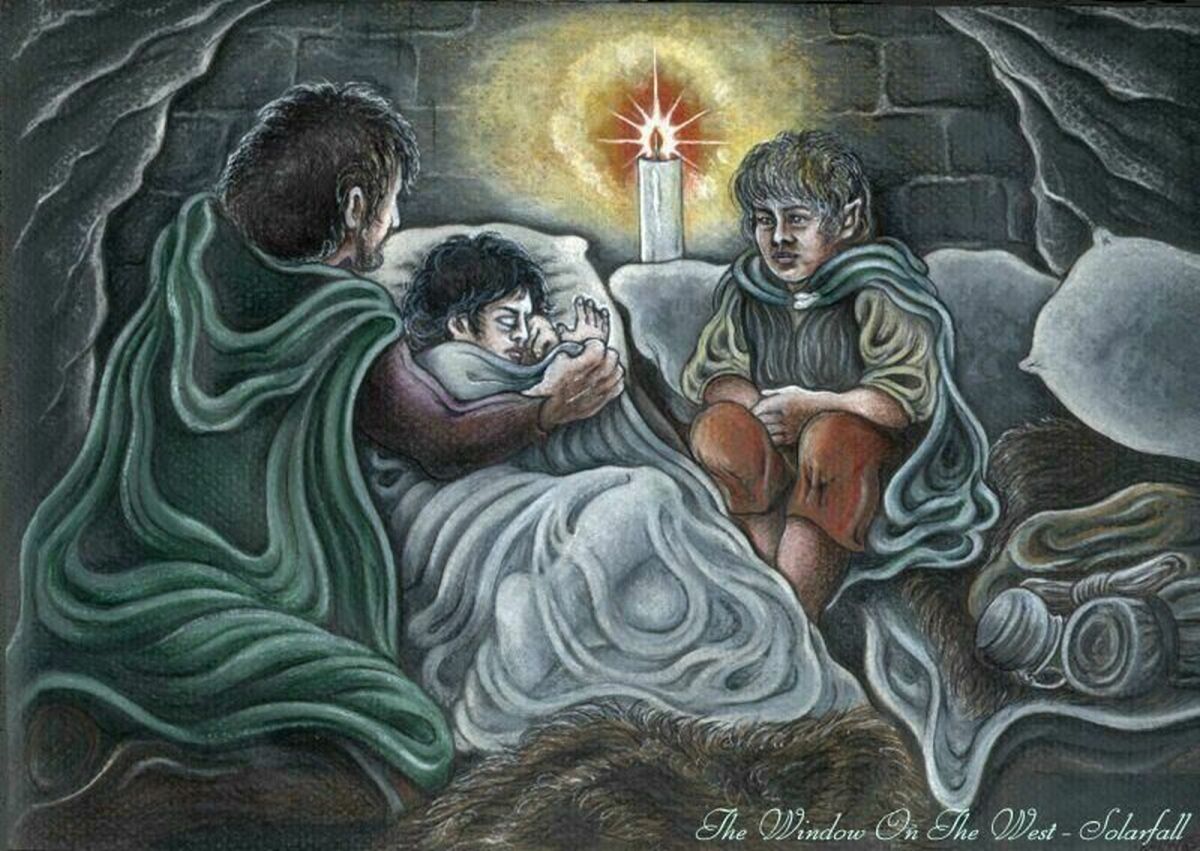
Faramir also seeks out knowledge and wisdom - much of which he learns from Gandalf, who he befriends - and studies history, not so he can lord it over people, but so he can make informed decisions and wise choices, often in conflict with the will of his father (who considers him a 'wizard's pupil'). When Frodo, Sam and Gollum wander into Ithilien forest, Faramir has his orders: he must slay all who trespass into Gondor's lands who do not directly serve the Steward Denethor. He could have chosen to have Frodo and Sam killed the minute he found them but does not...''I do not slay man nor beast needlessly, and not gladly even when it is needed,'' he tells Sam. As he talks with Frodo and slowly learns about the quest of the Fellowship and eventually - after a slip-up from Sam - the truth about ''Isildur's Bane'' and the madness of Boromir he is filled with grief and dismay rather then anger and Ringlust. Nor is the irony of the situation lost on him: ''So this is the answer to all the riddles!'' he cries. ''The One Ring that was thought to have perished from the world. And Boromir tried to take it by force? And you escaped? And ran all the way - to me! And here in the wild I have you: two Halflings, and a host of men at my call, and the Ring of Rings...a chance for Faramir, Captian of Gondor, to show his quality! Ha!'' Then comes the crucial moment of choice: ''Not if I found it on the highway would I take it,'' I said. Even if I were such a man as to desire this thing...still I should take those words as a vow, and be held by them. But I am not such a man.'' Faramir is a great enigma among Men: the desire for the Ring does not seem to exist within him. He waits and thinks, and taking Frodo and Sam to his secret refuge they dine with him and his men and take part only religious custom Tolkien reveals in the whole story (apart from Elven hymns): the Standing Silence. Later, after much talk, Frodo caves in and tells Faramir they are taking the Ring to Mordor in order to destroy it. Tired and weary he sways and almost falls, and Faramir catches him and carries him to a bed and covers him with warm blankets. Sam speaks for them both when he says: ''Goodnight, Captain, my lord; you took the chance, sir.'' ''Did I so?'' asks Faramir. ''Yes sir,'' answers Sam, ''and showed your quality: the very highest.'' To this Faramir gives the defining answer: a revelation of his true nature and humility: ''I had no lure or desire to do other then I have done.'' The next day he uses his authority to allow them to travel freely throughout the land of Gondor, and after providing them with food he embraces them and bids them farewell, and they separate and the Hobbits are left in peace for a time, and the world is once more saved, and doom is again averted.

Captain Faramir shows his quality - ''the very highest''

But no peace is granted to Faramir; for now that Boromir is dead he must do the duty of two Captains and his father pushes him hard, often sending him to were the fighting is the worst because no one else will go. When he learns of the choice of his son to let the Ring go to Mordor he is filled with more bitterness towards Faramir and more sadness about the death of Boromir. ''Boromir was loyal to me and no wizard's pupil. He would have remembered his father's need, and would not have squandered what fortune gave. He would have brought me a kingly gift.''  What Faramir did - the magnitude of his choice and  the fact that he was able to do it - is lost on Denethor, who can only gripe on how foolish his son and Gandalf are for sending the Ring of Power into the land of the Enemy in 'the hands of a witless halfling.' He sends Faramir out again to battle, unthanked and unblessed, to rally the soldiers and hold the forts of Osgilioth against Sauron's advancing armies. The hobbit Pippen has grown to admire Faramir, and his impression of him is one of profound insight: 'Here was one with an air of high nobility such as Aragorn at times revealed...one of the Kings of Men born into a later time, but touched with the wisdom and sorrow of the Elder Race...He was a captain that men would follow, that he [Pippen] would follow, even under the shadow of the black wings [of the Nazgul].'
 A simple Hobbit sees in Faramir what his father does not, but can do nothing help him (yet), and all of Faramir's choices and inner victories are looked upon with scorn, contempt or indifference (even by some readers). The only use Denethor sees in him is that he is a man of war who can keep men from deserting their posts and retreating before he (Denethor) wills it. Faramir obeys the command of his father and again proves his quality on the battlefield, being the last to retreat when Osgiliath falls, fighting in the rearguard so the remnants of his men can get to safety. But it is not enough; he is attacked again by the Nazgul and mounted warriors of Harad and falls, pierced by an arrow, and is rescued in the nick of time by Gandalf and Prince Imrahil. ''Your son has returned, lord, after great deeds,'' the Prince tells Denethor. The Steward of Gondor looks upon his remaining wounded son and sees the folly of his decisions and the hopelessness of the War and gives in to madness and despair and Gandalf and Imrahil must take command of the defense of Minas Tirith.

Prince Imrahil tends the fallen Faramir on the battlefield

I sometimes dare to imagine what it must have been like to have been Faramir then: one moment you're fighting for your life against foes whose one desire is the destruction of your City and the slaughter of your people; the fell Nazgul are swooping above you, your men are braking rank and fleeing in panic, you are exhausted, suffering from the Black Breath and wondering, perhaps, that maybe your father is right and that to have sent the Ring to Mordor was a deadly mistake and you have failed and the world will burn because of it. Then the arrow comes, and the pain, and the black oblivion of unconciseness...

Some readers do not understand the nature (or purpose) of characters like Faramir. They seem to be in some sort of denial that such people can exist: the selfless, the patient, the obedient, the wise, the long-suffering, the ones willing to go forth and do what needs to be done, regardless of what happens to them or what others think of them. Faramir is too nice, to kind, to 'heroic' for some to handle. Maybe they are envious of these characters, because they themselves do not measure up; they lack the integrity, the will or desire to become something far better and then what they are now, to become holy, saintlike; godlike, and to maintain this manner of being in the face of all adversity, even when everything is against you. Nothing seems to be in favor of Farmir: his big brother is dead, his country is being invaded, he has been wounded when his people need him the most, and the end of the world is at hand. His father objects the things he loves (music, ancient history, Gandalf his teacher), scorns his choices, and sees him only as someone who can lead men into battle and delay for a time the day of doom (and even then he sees Faramir as the inferior one; Boromir was more of a warrior after all). Faramir is the last man left in Minas Tirith (apart from Imrahil) who can successfully rally and lead the soldiers to face Mordor's minions and he is the last in the line of Stewards. When he falls, Denethor falls as well, having no more hope for the future, and the whole City of Gondor is thrown into dismay and grief.

 Denethor mourning Faramir

Such is the power of the hero, the righteous man; such is the reliance and trust people have in them. Who would we have if we didn't have our heroes and saints? Just our own greedy, cowardly, self-centered little selves, with no one to look up to or be en-heartened by. God, what a miserable world 'real life' can be when it is stripped of - or in denial of - its Great Ones. Why else have so many of us hauled ass to Middle-Earth in one form or another since 1955? Or to Narnia? Or the abbey of Redwall and the fortress of Salamandastron? Novelist Stephen Lawhead hits the nail perfectly on the head when he writes that:

''...the best of fantasy offers not an escape from reality but an escape to a heightened reality...In the very best fantasy literature, like The Lord of the Rings, we escape into an ideal world where ideal heroes and heroines (who are really only parts of our true selves) behave ideally. The work describes human life as it might be lived, perhaps ought to be lived against a backdrop, not of all happiness and light, but of crushing difficulty and overwhelming distress.''

'Crushing difficulty and overwhelming distress' can be a good summery of most of Faramir's life until Aragorn calls him back from the shadows of death and heals him. And with the return of the King comes also the reward of the faithful Steward. Faramir lives, and not so he can just fight and fight and ride around with a sword, but so Tolkien can grant him his true heart's desire - and Eowyn's as well: to live the way they have always wanted to live, in enjoyment of those things they have secretly hoped for but where never able to attain while their people needed them to war against the evil ones. They have fought their good fight and did not flinch from the horror and the death and now that the new Age has dawned they can rest from their labors and be at peace.

The reward of Farmir and Eowyn: the new-found love for each other
and the enjoyment of the world they helped save.


Best Faramir Quote: 
(concerning war and peace)

''For myself, I would see White Tree in flower again in the courts of the Kings, and the Silver Crown return, and Minas Tirith in peace: Minas Anor again as of old, full of light, high and fair, beautiful as a queen among queens...War must be, while we defend our lives against a destroyer who would devour all; but I do not love the bright sword for its sharpness, nor the arrow for its swiftness, nor the warrior for his glory. I love only that which they defend: the City of the Men of Numenor...''


That's it folks, that is the reason to become a hero and save the world: so that the things, the places, and above all the people you love can be kept in (or returned to) their state of beauty, of peace, and blessedness - free from evil and tyranny. It is not the heroics that are the chief thing but that which they defend. The reason there are so many anti-heroes running around today is because people can't - or won't - find things, people, beliefs or values that are worthy enough to defend. But in Middle-Earth there are more then enough good things for heroes - big and small - to fight and die for, and we fans want to be always right there with them, even if we don't fully know it. Some understand this; many do not. I myself will be forever grateful to Tolkien for the fact that he understood, and brought us endless joy in understanding it with him.